Masthead graphic based on a painting by Gudrun Thriemer.

Showing posts with label Taliban. Show all posts

Saturday, June 27, 2009

"Suicide blast hits Pakistan Kashmir," Al Jazeera, June 26, 2009.

Two soldiers have been killed and several others wounded after a suicide bomber attacked an army vehicle in Pakistan-controlled Kashmir, the military says.

The attack took place on Friday near the city of Muzaffarabad, the capital of the Pakistani-administered part of the divided Himalayan region.

"The bomber blew himself up near a military vehicle," a military spokesman said. "Two of our soldiers embraced martyrdom."

It was the first suicide attack in the Pakistani part of Kashmir, according to Choudhry Imtiaz, a senior administrative official.

The use of the tactic has raised fears that Taliban fighters from the northwest of the country are spreading their campaign against the government further afield.

  "It may be a sign of desperation at a time when they are coming under tremendous pressure because of the offensive."
Pakistani General Talat Masood (ret.)

Read the rest here =>

Recommend this Post


More =>

Sphere: Related Content

Wednesday, May 06, 2009

Jason Ditz, "Taliban seize city: Up to 500,000 flee," Antiwar.com, May 5, 2009.

The Swat district in Pakistan. Map from BBC.


The Tehreek-e Taliban Pakistan (TTP) has reportedly wrested control of the Swat Valley’s largest town, Mingora, from the North-West Frontier Province (NWFP) government and Pakistani security forces. The move comes just one day after the group announced that it was formally withdrawing from the controversial Swat Valley peace deal in response to ongoing military offensives in and around the valley.

With the truce apparently in ruins civilians are leaving the region, once a popular tourist destination, in droves and as many as 500,000 have reportedly already left their homes. Reports of indiscriminate shelling by the military and use of human shields by the militants are rampant, and the once sleepy valley is now one of the deadliest warzones on the planet.

  It seems the government forgot that the initial reasoning behind the concessions it made in the Swat Valley deal was that it had tried, unsuccessfully, to defeat the militants militarily.

Read the rest, with links, here =>

Recommend this Post


More =>

Sphere: Related Content

Monday, May 04, 2009

Nahal Toosi and Asif Shahzad, "Rising tensions threaten Pakistan, Taliban peace," Antiwar Newswire, May 3, 2009.

Pakistan's army and the Taliban blamed each other Sunday for a rise in tensions that threatened to destroy a much-criticized peace deal, just days before the Pakistani president heads to Washington for talks with President Barack Obama.

The army accused militants in the Swat Valley of looting, attacking infrastructure and killing one soldier. A Taliban spokesman said militants will start patrolling Swat's main town, and acknowledged that they cut the throats of two soldiers as revenge for the army killing two insurgents.

  Many Swat residents desperate for a stop to the fighting welcomed the deal, even if it didn't evict the Taliban.

Read the rest here =>
Recommend this Post


More =>

Sphere: Related Content

Sunday, April 26, 2009

Nancy A. Youssef and Jonathan S. Landay, "Events in Pakistan, Afghanistan overtake Obama's strategy," McClatchy, April 24, 2009.

[American big shots don't like Pakistan's elected government any better than they liked Musharraf. Yet Pakistan's renewed obsession with India may have something to do with the nuclear deal the Bush Administration negotiated with India. Note the absence of quotations in this article from any sources outside of Washington. Meanwhile, the European Parliament has passed a resolution against Afganistan's infamous "marital rape" law. -jlt]

WASHINGTON — Events in Pakistan and Afghanistan are already overtaking the Obama administration's month-old strategy for the two countries, and it needs to be modified even before it's been implemented, U.S. officials and experts said this week.

As Islamic militants continue their advance in Pakistan and press their attacks on overstretched U.S. and NATO forces in Afghanistan, many U.S. officials fear that the administration is running out of time to defeat what Secretary of State Hillary Clinton this week called a "mortal threat" to the world. Failure in either place, these officials argue, would guarantee failure in the other.

  Quotation
Author

Read the rest here =>

Note that three suicide bombers have hit the provincial governor’s compound in Kandahar =>Recommend this Post


More =>

Sphere: Related Content

Thursday, January 15, 2009

Ashfaq Yusufzai, "Culture:Pakistan: Artistes caught in crossfire," IPS, January 15, 2009.

[Notwithstanding the strangeness of "artistes" as an exotic item of vocabulary, the targeted group appears to be actors, dancers, singers, film makers, journalists, and girls' schools. The concern that what was formerly seen as tribal violence has spread beyond the FATA and into urban areas is confirmed here. The army's activities also seem to be a mixed bag. -jlt]

PESHAWAR, Jan 15 (IPS) - Arson attacks and killings have shut down girls’ schools and brought a thriving entertainment industry to its knees in the North West Frontier Province (NWFP).

  The government is engaged in fierce military operations with Islamic fighters in Swat and the tribal areas....Journalists are not liked by the army or Taliban

On Monday, renowned Pashto comedian Alamzeb Mujahid was abducted in broad daylight from the upmarket Hayatabad Township here in NWFP’s capital city by suspected Taliban gunmen.

The famous Pashto actor, who has been associated with national Pakistan Television (PTV) for the last two decades, has a fan following among the majority Pashtuns or Pakhtoons in Pakistan and neighbouring Afghanistan.

"He had just left his residence for office when three armed men bundled him into a truck and sped off," says Tariq Jamal, president of the Artistes’ Welfare Association Zoom (AWAZ).

Read the rest here =>
Recommend this Post


More =>

Sphere: Related Content

Thursday, December 04, 2008

"Pakistani Taliban hit NATO convoy for third consecutive day," Long War Journal, December 3, 2008.

[NATO's denial that these attacks are having any impact is predictable as are Rice's efforts to keep the South Asian theatre of the war on terror from unravelling in the wake of the Mumbai bombings. This is the first mention I have seen of the Chaman (also spelled Chamman) crossing in Pakistani Baluchistan across from Spin Boldak. -jlt]


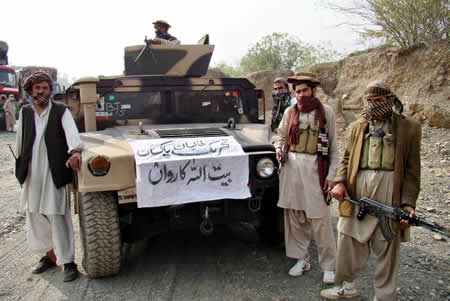
Baitullah Mehsud's Taliban pose in front of a captured US Humvee after hijacking a supply column on Nov. 10. Baitullah's Taliban flag is draped over the hood. Photo from AFP.


The Taliban have hit NATO's precarious supply line through Peshawar the third time in three days. Today, Taliban fighters detonated a bomb under a bridge as a NATO convoy was passing through Peshawar.

The bomb was detonated as the lead vehicle crossed the bridge. Two drivers and a driver's assistant were wounded, and the bridge was heavily damaged. The convoy was stopped dead in its tracks, but the Taliban did not follow up the bombing with an ambush.

  The bulk of NATO's supplies arrive in the port city of Karachi, move north to Peshawar, and head west to the Torkham crossing into Afghanistan and the final destination in Kabul. The rest of the supplies pass through the Chaman border crossing point in Baluchistan or arrive via air.

The bomb was detonated as the lead vehicle crossed the bridge. Two drivers and a driver's assistant were wounded, and the bridge was heavily damaged. The convoy was stopped dead in its tracks, but the Taliban did not follow up the bombing with an ambush.

A rocket attack at a truck terminal in Peshawar on Nov. 30 killed a driver and wounding another, and set three NATO shipping containers ablaze. The next day, a Taliban force of 25 men assaulted the truck terminal and killed two drivers and torched 21 trucks. Several Humvees being transported to Afghanistan were burned.

Read the rest here =>
Recommend this Post


More =>

Sphere: Related Content

Wednesday, November 12, 2008

"Taliban’s Khyber Pass Hijacking Threatens NATO Supply Route," Antiwar.com, November 11, 2008


[The Associated Press cites Fazal Mahmood, an administration official for the Khyber tribal region, as a source for its story which includes gunfire traded between Pakistani security forces and some 60 armed hijackers. However, neither deaths nor injuries are reported. -jlt]

Without firing a shot, dozens of militants along the Khyber Pass border between Pakistan and Afghanistan managed to hijack a convoy of trucks bound for NATO forces in Afghanistan. One of the trucks was carrying Humvees, which the militants proudly took photos in front of.

The hijacking threatens the only practical supply route for international troops in the landlocked nation. Hijackings on the route are not unheard of, though this is of a larger scale. This is the same border crossing which the Pakistan government closed in early September in the wake of a US ground assault into South Waziristan, and the latest incident may call further into doubt NATO’s supply line to international forces in Afghanistan.

The Pakistani government says its forces still hope to recover the hijacked trucks. It is unclear if the hijackings are related to a NATO air strike in Khyber Agency on Sunday, which killed eight people and reportedly came after a brief border exchange of fire.

Check out the links in this article and links to related articles here =>
Recommend this Post


More =>

Sphere: Related Content

Wednesday, October 15, 2008

"As Taliban influence grows, ‘shadow government’ seems an increasingly viable option to Afghans," Antiwar.com, October 14, 2008.

While coalition forces continue to kill militants in the provinces south of Kabul, the resilient Taliban forces continue to expand their influence in the area. Their presence is so overwhelming in some areas that they’re set up their own ’shadow government’ with its own court system. In the areas they control most completely, these government systems are considerably more powerful than their coalition-supported counterparts, and according to some reports, better accepted.

Christian Science Monitor reports that in provinces like Logar and Ghazni, locals are eschewing the wildly corrupt Afghan government in favor of the more credible Taliban alternative. Rather than dealing with a government court system rife with bribery, many are choosing to take their disputes to the sharia-based Taliban courts.

The Afghan government has insisted all along that the Taliban’s interest in the provinces begins and ends with their designs on recapturing Kabul. And with the Taliban openly patrolling the streets during the day, Afghan government police don’t dare enter many of the areas. Not that they’re needed, as many villagers say that crime has virtually vanished anyhow.

Links and related stories here =>
Recommend this Post


More =>

Sphere: Related Content

Wednesday, October 08, 2008

M K Bhadrakumar, "Taliban wake-up call for India," Asia Times, October 9, 2008.

[The US-India nuclear deal has done more than distract attention from the war in Afghanistan. It has created a call for similar treatment by Pakistan and aggravated an already unstable situation in the country through which NATO and the Americans must transport whatever supplies they don't fly into Afghanistan. The tightening noose is reminiscent of "The First Anglo-Afghan War." Surely the same mistakes won't be repeated. Air support is a big difference. Still, there is one line of analysis that says the Taliban won't mount a winter campaign. But Auckland's Folly took place in January. -jlt]

  From all accounts, the Taliban appear edging closer to the Afghan capital and tightening their control in the provinces ringing Kabul.

For the bulk of the Indian strategic community, the unthinkable is happening - the prospect of an Afghan settlement involving the Taliban is increasing.

A sensational expose by an investigative journalist, based on highly sensitive cable traffic last month between the French Embassy in Kabul and Quai d'Orsay in Paris, has thrown light on the Afghan war. For India, it is especially helpful in spotting the war, otherwise hidden behind the global banking meltdown and the India-United States civilian nuclear deal.

Claude Angeli, veteran journalist of Le Canard Enchaine, got hold of a copy of a coded cable by the French deputy chief of mission in Kabul, Francois Fitou, based on a briefing by the heavyweight

British diplomat, Sir Sherard Cowper-Coles, who serves as ambassador to Afghanistan. What Sir Sherard told Fitou in confidence is worth recalling:

"The current situation [in Afghanistan] is bad; the security situation is getting worse; so is corruption and the government [of President Hamid Karzai] has lost all trust."

# "The foreign forces are ensuring the survival of a regime which would collapse without them ... They are slowing down and complicating an eventual exit from the crisis, which will probably be dramatic."

# "We [NATO - North Atlantic Treaty Organization allies] should tell them [United States] that we want to be part of a winning strategy, not a losing one. In the short term, we should dissuade the American presidential candidates from getting more bogged down in Afghanistan ... The American strategy is doomed to fail."

# Britain aimed to withdraw its forces from Afghanistan by 2010.

# The only realistic outlook for Afghanistan would be the installation of "an acceptable dictator" and the public opinion should be primed for this.

Read the rest here =>
Recommend this Post


More =>

Sphere: Related Content

Wednesday, September 10, 2008

Joshua Foust, "The Damning Complexity of Afghanistan’s Border Politics," Registan.net, September 8, 2008.

[Not knowing who we are fighting means "shooting in the dark." Foust believes that "militant leaders" must be undermined "without bombs or guns or raids or torture—it requires a socio-political solution, one no one has yet come up with." The Registan writers are Americans, so when he says "we" that's who he is talking about. -jlt ]


"...we are at war with a not-insignificant percentage of Pakistan’s citizens, even if we are not yet at war with the state itself (and probably won’t be, now that Mr. Ten Percent is running things.) But figuring out exactly which of those citizens we are at war with is vitally important, and one I don’t yet trust our government to do reliably—in part because there is no fool-proof way of ensuring the “right” bad guys get killed by U.S. bombs and SOF."

Dexter Filkins wrote was can only be called—per Péter Marton’s formulation—a must-read. It is worth putting all else aside to read it. It is rare a piece of journalism from the NWFP manages to get both access to some of the main players while avoiding the annoying self-aggrandizement of playing up the danger while repeating little more than platitudes (I’m looking at you, Janine di Giovanni).

I find it hard to discuss this without gushing: it is a work of exception efficiency, summarizing two decades of difficult morass for a mass audience, without dumbing down any of the region’s horrid complexities. One part in particular, however, stood out for me:
“The government cannot do anything to us, because we are fighting the holy war,” he said. “We are fighting the foreigners — it is our obligation. They are killing innocent people.” Namdar’s aides, one of whom spoke fluent English, looked at him and shook their heads to make him speak more cautiously. Namdar carried on."


Read the rest of the article; check out the Registan.net blog here =>
Recommend this Post


More =>

Sphere: Related Content

Monday, June 16, 2008

"What Lt. Gen Natynczyk may not know," Canadian Daily Digest, September 4, 2007.

Wanderer has pulled together a number Syed Saleem Shahzad's articles from Asia Times online. World Report has often quoted him for reasons that may be similar to those that inclined Wanderer to assemble this list. Also some additional linkes that are useful. At the top, I have added links to Antiwar.com's top headlines for today (June 16, 2008.) In the wake of the Sarposa Prison break, NATO and American commanders have tried to maintain the illusion that the war is being won. Nothing could be farther from the truth, unless it comes directly from Washington.


from Canadian Daily Digest: Sep 4, 2007 by Wanderer

The term "embedded" is applied to Canadian journalists going into the field with Canadian Forces. The perspective of Syed Saleem Shahzad, Asia Times Online's Pakistan Bureau Chief, is unique. A 'guest' of the Taliban, he from time to time is "embedded" in Taliban groups and is privy to the continuing ebb and flow of political currents on both sides of the Durand Line.

Lt. Gen Natynczyk having attended the US Army War College and subsequently being appointed Deputy Commanding General, III Corps and Fort Hood and in January 2004, being deployed with III Corps to Baghdad, Iraq, serving first as the Deputy Director of Strategy, Policy and Plans and subsequently as the Deputy Commanding General of the Multi-National Corps (Iraq), will be aware of the directions of the United States.

Is he as well aware of those with whom our Forces and theirs are at war? Not through the North American media, though he may be briefed by his staff.

The writings that follow trace Shahzad as he travels with his Taliban guide in and out of Kunar province which in his words serves "as the start of a natural route up to the northeastern province of Kapisa, from where, ultimately, the Taliban hope to enter into Kabul."

Joe Hueglin

+ Map of Afghanistan's Provinces

"In another development, the United National Front of Afghanistan, representing the strongest northern Afghan warlords and politicians, and the strongest force in the south, the Taliban and HIA, have admitted to opening channels of discussion. The
US-backed Karzai is the only stumbling block - at this stage he is not acceptable to the southern strongmen or the northern ones."


May 22, 2008 Part 1: Ducking and diving under B-52s
May 22, 2008 Part 2: A fighter and a financier
May 28, 2008 Part 3: In the footsteps of Osama ...
May 31, 2008 US terror drive stalled in political quagmire
June 3, 2008 A struggle between war and peace

Related articles:

Kapisa province: The Taliban's gateway to Kabul

Tracking the Coalition�s Afghan spring offensive

Accompanying MapRecommend this Post


More =>

Sphere: Related Content

Tom Coghlan and Colin Freeman, "How Taliban Sprang 450 Terrorists From Kandahar's Sarposa Prison In Afghanistan," Sunday Telegraph, June 15, 2008.

Taliban-driven getaway minibuses were waiting nearby with engines running.


With the latest outrage, the insurgency has shown that its ability to stage 'spectaculars' is undiminished by setbacks in the field.

Overlooking the dusty road into one of Afghanistan's most lawless cities, the newly-painted guard towers of ­Kandahar's Sarposa prison are supposed to be a reminder to local people of how justice has finally come to town.

In recent years, coalition ­officials have spent millions turning the 60-year-old building into a showcase facility for Afghanistan's new government, issuing guards with crisp new uniforms and giving them lessons on how to treat their charges humanely.

Rather less attention, however, seems to have been spent on the jail's most basic function – security.

Yesterday, Sarposa's entire population of 1,100 inmates – including murderers, bandits and about 450 hardened Islamic militants – was enjoying freedom after an audacious Taliban attack engineered one of the biggest mass jail breaks in history.

Read the rest here =>
Recommend this Post


More =>

Sphere: Related Content

Friday, December 14, 2007

"Afghanistan, U.K.: London's 'New' Taliban Strategy," StratFor, December 12, 2007.

The United Kingdom appears to be trying a new tack in dealing with the Taliban: undermining the movement from within. However, London's approach suffers from a number of problems, and in any case, it already has been tried -- unsuccessfully -- by the United States. Ultimately, attempts to divide the Taliban from within will not work unless the movement faces competition from more pragmatic groups that hold the same legitimacy in the eyes of the people.

[...]

Islamabad has now lost the control it once had over the Taliban, to the point that Pakistan has its own Taliban insurgency in the Federally Administered Tribal Areas and the North-West Frontier Province. In addition, Talibanization now is rapidly spreading out of Pakistan's peripheral Pashtun areas and into its Punjabi heartland. The Pakistanis cannot offer much help at the moment.

Read the article.

Recommend this Post


More =>

Sphere: Related Content