Masthead graphic based on a painting by Gudrun Thriemer.

Showing posts with label Lebanon. Show all posts

Saturday, May 16, 2009

"Tel Aviv hands over maps of Lebanon cluster munitions: UNIFIL," Leila Magazine, May 12, 2009.

Israel handed over to U.N. peacekeepers on Tuesday maps of where it dropped cluster bombs in Lebanon during the 2006 war with Hezbollah fighters, the UNIFIL peacekeeping force said.

The United Nations and the Lebanese government have repeatedly called on Israel to hand over the maps of where it dropped the munitions, most of which were fired in the last 72 hours of the 34-day war.

  Dozens of people have been killed and several hundred wounded in mainly rural south Lebanon by munitions left behind by the 2006 war.

Read the rest here =>Recommend this Post


More =>

Sphere: Related Content

Friday, January 16, 2009

David Schenker, "As Islamists exploit financial crisis, Lebanon stands fast," Christian Science Monitor, January 15, 2009.

Washington - More than two weeks into the Israeli-Hamas war, the eyes of the world are narrowly focused on the crisis in Gaza. In the Middle East, however, it is not just the Palestinians and Israelis who are suffering, and it is not only Hamas which hopes to capitalize.

  Like other Middle Eastern states, the local bourse has declined somewhat, but real estate markets hadn't crashed, and banks were not failing....Years ago, Riad Salameh issued a [Central] bank circular prohibiting Lebanese banks from subscribing to subprime mortgage products. This rule complemented already extant regulations, limiting banks' participation in other risky products like derivatives.

Lost amid the ongoing hostilities is the profound impact of the global economic crisis on the Middle East. Like the rest of the world, Arabs have also found themselves victims of the downturn. Even the Gulf, still floating on a cash cushion from the recent oil boom, is tightening its belt.

Read the rest here =>
Recommend this Post


More =>

Sphere: Related Content

Monday, January 12, 2009

Nicholas Blanford, "Who fired on Israel from Lebanon?" Ya LIbnan, January 9, 2009.

[The Israeli's do understand "proportionate response." -jlt]

Beirut - Lebanon's traditionally volatile border with Israel reprised its role as a bellwether of Israeli-Arab tensions Thursday morning as unknown militants fired at least three Katyusha rockets into Israel.

  Lebanon heads to the polls in June for knife-edge parliamentary elections.

It was the third such attack since the end of Israel's 2006 Lebanon war. The first two attacks involved a number of 107-mm Katyusha rockets, which have a range of seven miles, but were poorly executed — some did not explode, one did not make it across the border, and one did not even leave the launcher.

This time, however, the rocket attack showed a greater level of proficiency. Larger-caliber 122-mm rockets, with a range of 12 miles, were employed and carefully aimed at Nahariyah, a coastal town six miles south of the Lebanon border with a population of 50,000. Two Israeli civilians were slightly hurt when one of the rockets struck the roof of a nursing home.

The intention appears to be to keep Israel on edge along its northern border without eliciting a disproportionate reaction. Indeed, Israel's response to the Katyusha attack — firing a few artillery shells into a deserted valley in southern Lebanon — neatly fits within the finely calibrated rules that define violence and retaliation along the border, rules tacitly observed by both Israel and Hezbollah, the radical Shi'ite group that dominates much of Lebanon. Israel's artillery shelling was a step up from no response at all — which was how Israel greeted the two earlier rocket attacks. But it was sufficiently limited to deny Hezbollah a pretext to respond in kind. "I don't think it will get worse than that," says Timur Goksel, university lecturer in Beirut and former long-serving official with the U.N. peacekeeping force in southern Lebanon. "You don't open a second front with a couple of Katyusha rockets."

Read the rest here =>
Recommend this Post


More =>

Sphere: Related Content

Thursday, January 08, 2009

Grace Walsh, "Lebanese rocket fire hits Northern Israel; Hezbollah deny involvement," IMEMC, January 8, 2009.

At approximately 8am on Thursday morning, rocket fire hit the Northern Israeli territory of Nahariya. No injuries were reported, but the residents of a nursing home that was hit in the attack are being treated for shock.

Hezbollah and sources in Beirut, have denied responsibility for the rockets, which came from the Litani River area, near the Israeli border, and were short-range.

Read the rest here =>
Recommend this Post


More =>

Sphere: Related Content

Friday, November 28, 2008

"Lebanon asks Iran to supply its army with midsize weapons," Ha'aretz, November 26, 2008.

  On Monday, Suleiman became the third Lebanese president to visit Iran since its 1979 Islamic revolution.

Lebanese President Michel Suleiman recently asked Iran for medium-sized weapons for Lebanon's army, in a move aimed at shifting Iran's assistance from the country's militant Hezbollah movement to the state, a Lebanese government official said Wednesday.

The official, who requested anonymity, said Suleiman had emphasized during a two-day visit to Tehran earlier this week that he was not seeking long-range missiles or jet fighters, but rather modern medium arms that would help the Lebanese army combat terrorism and maintain national security.

The source told Deutsche Presse-Agentur that Iranian President Mahmoud Ahmadinejad had assured his Lebanese counterpart that Iran would be ready to assist Lebanon in this regard.

Read the rest here =>
Recommend this Post


More =>

Sphere: Related Content

Friday, October 31, 2008

"Bolton links US election to instability in Lebanon," Daily Star (Lebanon), November 1, 2008.

[Never before in the history of the planet has a former acting ambassador to the UN been so interesting to the press--though less and less as reality sinks in. -jlt]

BEIRUT: Former acting US Ambassador to the United Nations John Bolton on Friday linked his country's phase of transition to instability in Lebanon. In an interview with the Al-Arabiyya satellite news channel, Bolton expressed fears for "stability and democracy in Lebanon" and "the government of Prime Minister [Fouad] Siniora." These fears were rooted in the role Syria and Hizbullah may jointly play in Lebanon, he said. "This transitional period in the United States and Israel may have been difficult on the Lebanese state," Bolton told Al-Arabiyya.

[However, the Lebanese state may have other difficulties.]

BEIRUT: Twelve Israeli military aircraft flew over southern and northern Lebanon on Friday in violation of a United Nations resolution, the Lebanese Armed Forces said in a statement. Six Israeli jets flew over the southern village of Alma al-Shaab for about 30 minutes during the morning, while six other planes overflew the northern region of Batroun, also for 30 minutes, a statement said. "The Israeli enemy violated Lebanese airspace and Resolution 1701," which the United Nations Security Council passed in August 2006, the statement said. - AFP
Recommend this Post


More =>

Sphere: Related Content

Friday, September 26, 2008

"Hezbollah has a chance to put its money where its mouth is," The Daily Star, September 20, 2008.

  Like countless other places of worship across Lebanon, the synagogue was ironically damaged by Israeli forces, but unlike most mosques and churches that have been or are being rebuilt, Maghen Abraham has remained in a state of disrepair since 1982.

BEIRUT – Since its emergence into the public sphere in 1985, Hezbollah has frequently been subjected to hostile media coverage that has effectively branded the group as a "terrorist," "Islamo-fascist," "anti-Semitic" entity. The party's repeated attempts to dispel these misperceptions have had limited effect, largely because the debate boils down to Hezbollah's word against that of the vast majority of the Western media. But the party is currently facing an opportunity to back some of its oft-repeated words with action––and thereby help repair its image both in Lebanon and abroad.

Many Hezbollah officials have tried, especially in recent years, to stress that although the resistance arm of the party is at war with Israel, the group does not have any animosity toward Judaism or members of the Jewish faith. But because the Jewish community in Lebanon has dwindled to such small numbers, rarely does Hezbollah have a chance to demonstrate the sincerity of these statements. But an opportunity to do just that might be located in Downtown Beirut's Wadi Abu Jamil district, the home of the Maghen Abraham Synagogue.

Like countless other places of worship across Lebanon, the synagogue was ironically damaged by Israeli forces, but unlike most mosques and churches that have been or are being rebuilt; Maghen Abraham has remained in a state of disrepair since 1982. A leader of Lebanon's tiny Jewish community, Isaac Arazi, is reportedly engaged in an effort to raise $1 million to restore the synagogue to its previous condition, but he has so far only secured a small fraction of the needed funds. Hezbollah spokesman Hussein Rahal has already been quoted in the Western media as saying that his party supports the restoration of the building, so why doesn't the party demonstrate the truth of these words by acting on them?

Hezbollah has already helped several churches in the country secure the funds needed to rebuild their properties that were damaged by the Israelis during their 2006 bombardment of Lebanon, including the Mar Youssef Church in the southern suburbs of Beirut. It is only logical that the party's leadership would be willing to expand this initiative and help rebuild the Maghen Abraham Synagogue, or at least call upon its supporters to contribute to the Jewish community's fundraising effort. Such a gesture would go a long way toward demonstrating Hezbollah's genuine commitment, as expressed by the party's leader, Sayyed Hassan Nasrallah, to preserving Lebanon's pluralism.
Recommend this Post


More =>

Sphere: Related Content

Tuesday, September 09, 2008

Andrew Wander, "Zawahri questions Hizbullah's 'victory' in 2006 summer war," The Daily Star, September 10, 2008.

Al-Qaeda's militant Sunni leadership is unhappy that Shiite religious leaders have not issued religious edicts declaring jihad against Western troops stationed in Iraq and Afghanistan.
BEIRUT: Al-Qaeda number two Ayman al-Zawahri launched a stinging verbal attack against Hizbullah and the Lebanese government in a video broadcast by Arab broadcaster Al-Jazeera news satellite channel Monday. The senior jihadist commander, who is often described as Osama bin Laden's right-hand man, questioned whether Hizbullah chief Sayyed Hassan Nasrallah was right to hail the 2006 summer war as a "victory."

"Hizbullah has not obtained any victory in Lebanon against Israel," Zawahri said. "The most bizarre and astounding thing is that Hassan Nasrallah celebrates a victory every year. For what? For making them retreat 30 kilometers, for the demilitarization of the region and the acceptance of 15,000 crusader soldiers that separate the mujahedeen from Israel?"

Read the rest here =>
Recommend this Post


More =>

Sphere: Related Content

Wednesday, September 03, 2008

"Israeli warplanes terrorize residents of Tyre," Daily Star, September 4, 2008.

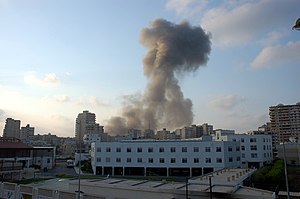
Smoke over Tyre after Israeli
bombardment in 2006 war

[It seems to me that this kind of provocation has been reported less since than it was before the 33-day Lebanon war (2006). But it does happen. For anyone who has lived with sonic booms, it is easy to see how everyday citizens would regard them as rude and provocative, especially when they come from the aircraft of a nation which has invaded them twice since 1982 (see photo).

Most North Americans think that the kidnapping of Israeli soldiers by Hezbollah was a bolt out of the blue. But the truth is that there is a history of provocations on both sides. As the article makes clear, some Lebanese see the flights not only as aggressive provocation but also as meddling in their internal politics. Israeli strategists are still waiting for the Lebanese backlash against Hezbollah. Some people never learn. -jlt]

For their part Israeli cabinet ministers have warned that Lebanon's civilian infrastructure could be targeted in any new war, now that the Hizbullah-led opposition has secured veto powers in a national unity government.


TYRE: Six Israeli warplanes flew over South Lebanon and broke the sound barrier twice over the port city of Tyre on Wednesday, a security official said. "Six Israeli warplanes flew all over southern Lebanon and the city of Tyre at low altitude for more than an hour and broke the sound barrier twice over Tyre," the official told AFP.

The overflight prompted scared shoppers to flee Tyre's main market, witnesses said.

Read the whole article here =>
Recommend this Post


More =>

Sphere: Related Content

Saturday, August 23, 2008

Hussam Ittani, "Haste," As-Safir, August 20, 2008.

Translation available from MidEastWire

While democracy, as interpreted by George Bush and his ilk, is an unmarketable product here in our Arab lands, does our glee at the Russian victory mean that our only viable alternative for American “democracy” and policy is to get into more alliances with tyranny and oppression?...”
- As-Safir, Lebanon

Ittani: Some of the Arab responses and reactions to the war in Caucasia can be described as hasty. These reactions are filled with comparisons between what befell the United States and its allies in Iraq, Lebanon and Palestine and the defeat of the Georgian army at the hands of the Russian forces. The conclusions from these comparisons confirm once again the retreat of the American role in the world and the rise of competing forces led by Russia and China. These opinions are not devoid of truth, but like all oversimplifications, contain more mistakes than accurate observations. The belief in the existence of a link between the events in Caucasia and the Middle East presupposes the existence of a single American policy towards both these regions.

Ittani argues that the existential political crisis in Lebanon is "far from over;" that ongoing events in Gaza and the West Bank sound "the death knells of the Palestinian cause as the world has known it since 1965;" and that "gloating at the continuous failures to build a new state in Iraq hides the inevitable question about the viable alternatives;" which is much the same question raised by the Russian victory in Georgia (see above).

Read the rest here =>
Recommend this Post


More =>

Sphere: Related Content

Saturday, June 21, 2008

Sadegh Zibakalam, "The roots of Iranian involvement in Lebanon," BitterLemons International, June 12, 2008.

Iranian involvement in Lebanon is first and foremost a defensive strategy adopted by the Iranian leaders against their powerful enemy, the United States.

Contrary to common perceptions, Iranian involvement in Lebanon did not begin with the Islamic Revolution in 1979. First contact between Iranian Shi'ites and Lebanese Shi'ites was established at the beginning of the sixteenth century when some of the senior Lebanese Shi'ite ulema (clergy) were invited to Iran by the newly established and powerful Safawid dynasty.

The Safawid rulers converted Iranians to Shi'ism and made it the official religion in Iran. They invited Shi'ite scholars from Oman, Yemen and Lebanon to help them construct the theoretical framework for a Shi'ite state in a country where Shi'ism had hitherto been only a minority sect. Jabal Ameli and Sadr were two senior Shi'ite scholars who went to Iran from Lebanon and stayed at the Safawid court for many years.

Read the whole article here =>


Sadegh Zibakalam is professor of Iranian studies at Tehran University.Recommend this Post


More =>

Sphere: Related Content

Mark Perry,"America's victory in Lebanon," BitterLemons, June 12, 2008.

This article appeared originally in BitterLemons-International, and was reproduced on Conflicts Forum where Perry is a co-founder.

The prime minister of His Majesty’s Government, the rotund Lord North–reputed (falsely) to be the bastard son of George III–once sniffed to his cabinet that if it were not for the interference of France, the American colonists would surely return to the loving arms of their mother country. He said this in the midst of the dark winter of 1776, when George Washington’s ill-clad army was traversing the ice-clogged rivers of New Jersey to do battle with Hessian mercenaries that the parsimonious North had hired. The result was predictable: when Washington attacked the Hessians (groggy from their Christmas libations), the British-paid militia dropped their arms and fled, giving the Americans their first military triumph.

North had great faith both in British power and in the Sceptred Isle’s capacity for good. He sent several messages to America’s leaders: all we want is what is good for you, he said–our interests are secondary. When told that his messages were greeted with derision, that the colonists had formed armed militias (those words, exactly) and that His Majesty should send an army to defeat them, North scoffed. The Royal Navy was the greatest navy in the history of the world; entire nation’s quelled at its appearance. “Four or five frigates will do the business without any military force,” he clucked dismissively. And so it was that while North’s Hessians were fleeing pell-mell through the streets of Trenton, the Royal Navy was blithely riding at anchor offshore–waiting for the rag tags to wet their homespun breeches.

Not all historical parallels are exactly parallel. Trenton is not Beirut, the Continental Army is not Hizballah, and Lebanon’s internal security forces are not mercenaries. And yet… and yet, I am struck by how George Bush’s “projection of American power” proved as misguided as North’s, and by how America’s armed and trained security force–Lebanon’s ISF–evaporated as quickly as North’s paid mercenaries when faced by a dedicated opponent. This all happened in May, you might remember, and I was there in the immediate aftermath of the events. I was told that the Internal Security Forces (well turned out, with shiny SUVs) disappeared suddenly: “not in days, but hours.” Then too, the dispatch of the USS Cole to the shores of Lebanon had as much impact as North’s deployment of the 64-gun HMS Intrepid (His Majesty’s mightiest ship), some 240 years ago. No one was frightened. And the $464 million paid by America to train the ISF was as poorly spent as the Crown’s money to bribe the Elector of Hessen-Kassel to equip some 17,000 Germans to fight the colonials. Like the ISF, they were there to hold ground, not to fight for it.

Think of how the Hessian’s felt as what was left of them ran from the frozen fields of Trenton, leaving their dead behind. They had been promised that should there be trouble with the colonials, the vaunted British Army, just over the hill, would come to their rescue. It had not happened. So too, in May, the ceaseless American pledge of support that they (we!) would stand by our allies in Lebanon (all we want is what is good for you, we had said) had proven hollow. The Redcoats did not come to help their allies in Trenton, nor the Marines to help ours in Beirut. Like the Intrepid (which boarded New Yorkers loyal to the British crown–to save them from the mob) the USS Cole’s real purpose in steaming off of Lebanon’s shore can now be told: it was not to make a show of American force, but to aid in the evacuation of US nationals.

The message could not have been any plainer: you’re on your own.

It is said that Lord North was an intelligent man but out of his depth. In fact, he was really very stupid. In the wake of the American victory at Trenton, he dispatched more troops to the colonies, adopted a harsher military strategy (which alienated the only friends the British had left in America) and abandoned his normally frugal financial policies. In so doing he nearly destroyed the British Army and set the British government on a policy that almost ended in its bankruptcy–in 1820, the Intrepid was sold for the cost of wood and iron to help pay down the government debt.

George Bush is not anything like Lord North: he may be out of his depth, but he’s not stupid. Having no Marines to dispatch (they are busy just now, you might have heard, in Iraq), he has instead deployed the American secretary of state to explain away this humbling of American power. Not surprisingly this, like so much else, has proved beyond her ken: “Hizballah has lost something very important which is any argument that it is somehow a resistance movement on behalf of the Lebanese people,” she told a group of journalists. She then thought for a moment. “Yes, I think they have been hurt in the long term.”

You can imagine how relieved the American people were to hear this. For a minute there, we actually thought we might have suffered a defeat.
Recommend this Post


More =>

Sphere: Related Content

Saturday, June 14, 2008

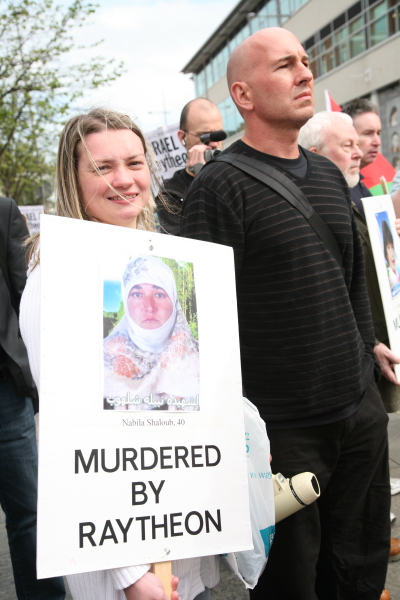
Ratheon 9 acquitted, Derry Antiwar Coalition/IndyMedia Dublin

Image from 27th May 2008 outside Laganside solidarity protest and (c) Paula Geraghty

Related Link: http://www.raytheon9.org

[This story from Ed Corrigan via Window on Palestine. -jlt]

"The Raytheon 9 have been aquitted today in Belfast for their action in decommissioning the Raytheon offices in Derry in August 2006. The prosecution could produce not a shred of evidence to counter our case that we had acted to prevent the commission of war crimes during the Lebanon war by the Israeli armed forces using weapons supplied by Raytheon."

After their acquittal on three charges of criminal damage to the computer equipment and office of Raytheon, the world's largest supplier of Guided Bomb Units, Colm Bryce and Eamonn McCann spoke to supporters and press outside the court. Colm Bryce began:

The Raytheon 9 have been aquitted today in Belfast for their action in decommissioning the Raytheon offices in Derry in August 2006. The prosecution could produce not a shred of evidence to counter our case that we had acted to prevent the commission of war crimes during the Lebanon war by the Israeli armed forces using weapons supplied by Raytheon.

We remain proud of the action we took and only wish that we could have done more to disrupt the 'kill chain' that Raytheon controls.

This victory is welcome, for ourselves and our families, but we wish to dedicate it to the Shaloub and Hasheem families of Qana in Lebanon, who lost 28 of their closest relatives on the 30 July 2006 due to a Raytheon 'bunker buster' bomb.

Their unimaginable loss was foremost in our minds when we took the action we did on 9 August, and the injustice that they and the many thousands of victims of war crimes in Lebanon, Palestine, Iraq and Afghanistan have suffered, will spur us on to continue to campaign against war and the arms trade that profits from it.

We said from the beginning that we came to this court not as the accused but as the accusers of Raytheon. This court case proved that Raytheon in Derry is an integral part of the global Raytheon company and its military production. This is no longer a secret or in doubt. Raytheon have treated the truth, peaceful protest, local democracy and this court with complete contempt. The most senior executive who appeared said that the charge that Raytheon had 'aided and abetted' the commission of crimes against humanity was "not an issue" for him. Raytheon should have that contempt repaid in full and be driven out of Derry and every other place they have settled. They are war criminals, plain and simple. They have no place in our society and shame on all those in positions of power or influence who would hand them public funds, turn a blind eye to their crimes, cover their tracks or make excuses for them.

These crimes continue daily and hourly in the Middle East. It is up to those of us who oppose those wars of domination and occupation to build a movement that matches the enormity of what is being done by Western governments. We hope that this victory gives courage and heart to all those involved in that movement and the many more who need to be for us to achieve our aim of stopping these wars. Until then, the very least we can do, to show solidarity with our brothers and sisters in the Middle East is to dissociate ourselves from the corrupt governments of the US and Britain. That means opposing the visit to Belfast of the world's biggest war criminal, George W Bush on 16 June.

We feel totally vindicated by this decision and wish to extend our heartfelt thanks to all of those who gave us support, especially to our families and friends, to the members of the Derry Anti War Coalition and the Irish Anti-War Movement , to our excellent legal teams. Of course, we particularly want to thank the jury who listened intently through three weeks of evidence before ensuring that justice was done today.

Eamonn McCann then addressed supporters and press saying:

The outcome of this case has profound implications.

The jury has accepted that we were reasonable in our belief that: the Israel Defence Forces were guilty of war crimes in Lebanon in the summer of 2006; that the Raytheon company, including its facility in Derry, was aiding and abetting the commission of these crimes; and that the action we took was intended to have, and did have, the effect of hampering or delaying the commission of war crimes.

We have been vindicated.

We reject entirely and with contempt the statement by Raytheon this evening suggesting that the result of the trial gives them concern about the safety of their employees. This is an abject attempt to divert attention from the significance of the outcome. Not a shed of evidence was produced that we presented the slightest danger to Raytheon workers. The charge of affray was thrown out by the court without waiting to hear defence evidence.

Our target has always been Raytheon as a corporate entity and its shareholders and directors who profit from misery and death.

There is now no hiding place for those who have said that they support the presence of Raytheon in Derry on the basis that the company is not involved in Derry in arms-related production. We have established that not only is the Derry plant involved in arms-related production, it is also, through its integration into Raytheon as a whole, involved in war crimes.

We call on all elected representatives in Derry, and on the citizens of Derry, to say now in unequivocal terms that the war criminal Raytheon is not welcome in our city.

We call on the office of the Attorney General and the Crown Prosecution Service, in light of this verdict, to institute an investigation into the activities of Raytheon at its various plants across the UK, with a view to determining whether Raytheon is, as we say it is, a criminal enterprise.

We believe that one day the world will look back on the arms trade as we look back today on the slave trade, and wonder how it came about that such evil could abound in respectable society. If we have advanced by a mere moment the day when the arms trade is put beyond the law, what we have done will have been worthwhile.

We took the action we did in the immediate aftermath of the slaughter of innocents in Qana on July 30th 2006. The people of Qana are our neighbours. Their children are the children of our neighbours. We trashed Raytheon to help protect our neighbours. The court has found that that was not a crime. This what the Raytheon case has been about.

We have not denied or apologised for what we did at the Raytheon plant in the summer of 2006. All of us believe that it was the best thing we ever did in our lives.
Recommend this Post


More =>

Sphere: Related Content

Ramzy Baroud, "Engaging Syria: Losing ground," Palestine Chronicle, June 6, 2008.

The failure to completely marginalise Hamas led to immense human suffering among Palestinians, but actually strengthened the democratically elected group. Every attempt at eradicating Hizbullah yielded the exact opposite outcome, and the group is now stronger than ever. The burning Israeli desire to ignite another US war against Iran is being met with little enthusiasm in the US as Bush's days in office are numbered.

On 15 May, President Bush gave a speech before the Israeli Knesset decrying "radicals and terrorists" (basically anyone who opposes the United States and Israel). His archaic references to the "promised land" and "chosen people" certainly appealed to the equally outdated and exclusivist views of many, though not all, Israeli Knesset members who reportedly saw in Bush the quintessential Zionist.

A few days later, Bush took his message to Sharm El-Sheikh, stating, "we must stand with the good and decent people of Iran and Syria, who deserve so much better than the life they have today. Every peaceful nation in the region has an interest in stopping these nations from supporting terrorism."

Yet, on 21 May, media reports revealed that Israel and Syria were engaged in mediated peace talks in Turkey. Both sides sounded upbeat, with Syrian officials stating that Israel showed readiness to withdraw from the entire Golan Heights, which it occupied in 1967 and illegally annexed in 1981.

Within days of Bush's seemingly firm stance against "appeasement" -- which ignited a political storm back in his own country -- Israel seemed ready to do exactly what the US president had so ardently opposed.

Read the rest here =>


Ramzy Baroud (www.ramzybaroud.net) is an author and editor of PalestineChronicle.com. His work has been published in many newspapers and journals worldwide. His latest book is The Second Palestinian Intifada: A Chronicle of a People's Struggle (Pluto Press, London).Recommend this Post


More =>

Sphere: Related Content

Thursday, May 29, 2008

Robert Fisk, "So just where does the madness end?" The Independent, May 1, 2008.

[Fisk's report during Bush's visit to the Middle East is still timely. As usual, he includes details we are unlikely to have heard about from our homegrown sources. -jlt]

...Sleiman gets on well with Damascus. He is not going to lead his soldiers into a pro-American war against Hizbollah. And the Lebanese are not going to join Bush's insane "jihad" against the "world terror".

I am not sure what was the worse part of this week. Living in Lebanon? Or reading the outrageous words of George Bush? Several times, I have asked myself this question: have words lost their meaning?

So let's start with lunch at the Cocteau restaurant in Beirut. Yes, it's named after Jean Cocteau, and it is one of the chicest places in town. Magnificent flowers on the table, impeccable service, wonderful food. Yes, there was shooting at Sodeco – 20 yards away – the day before; yes, we were already worried about the virtual collapse of the Lebanese government, the humiliation of Sunni Muslims (and the Saudis) in the face of what we must acknowledge as a Hizbollah victory (don't expect George Bush to understand this) and the danger of more street shooting. But I brought up the tiny matter of the little massacre in northern Lebanon in which 10 or 12 militiamen were captured and then murdered before being handed over to the Lebanese army. Their bodies were – I fear this is correct – mutilated after death.

Read the rest in The Independent =>


Robert Fisk's new book, The Age of the Warrior: Selected Writings, a selection of his Saturday columns in The Independent, is published by Fourth Estate.Recommend this Post


More =>

Sphere: Related Content

Tuesday, May 27, 2008

Rami G. Khouri, "New rules for the Middle East," International Herald Tribune, May 26, 2008.

...we now have a rare moment in the Middle East. Iran, Turkey, all the Arabs, Hezbollah, Hamas, and Israel all share one and only one common trait: They routinely ignore the advice, and the occasional threats, they get from Washington.


The accord that has resolved the immediate political crisis in Lebanon is the latest example of the new political power equation that is redefining the Middle East. It reflects both local and global forces, and 18 years after the Cold War ended, provides a glimpse of what the post-Cold War world will look like - at least in the Middle East.

Several dynamics seem to be at play, but one stands out as paramount: We are witnessing the clear limits of the projection of American global power, combined with the assertion and coexistence of multiple regional powers (Turkey, Israel, Iran, Hezbollah, Syria, Hamas, Saudi Arabia, etc.). These local powers tend to fight and negotiate at the same time, and ultimately prefer to make reasonable compromises rather than perpetually wage absolutist battles.

The Doha accord for Lebanon was much more than simply a victory for Iranian-backed Hezbollah over the American-backed alliance. It is the first concrete example in the Arab world of a negotiated, formal political agreement by local adversaries to share power and make big national decisions collectively, while maintaining close strategic relationships with diverse external patrons in the United States, Iran, Saudi Arabia and Syria.

The Lebanese agreement (unlike the failed Fatah-Hamas unity government) is likely to succeed because all the parties know that to live together peacefully they must make mutual compromises. This accord has been forged in the furnace of Middle Eastern demographic and political realism, in contrast to the hallucinatory absolutism that often drives American-Israeli policy

This is not a full defeat for the United States - it's more like a draw. It puts into concrete political form the most powerful force that has defined the Middle East in recent decades: the willingness of individuals, political movements and some governments to openly defy, challenge, resist and occasionally to fight the United States, Israel and their Arab and other allies.

Read the rest here =>


Rami G. Khouri is editor-at-large of The Daily Star and director of the Issam Fares Institute for Public Policy and International Affairs at the American University of Beirut. Distributed by Agence Global.Recommend this Post


More =>

Sphere: Related Content

César Chelala, "Dignifying Lebanon's past," Common Ground News - Partners in Humanity. English Edition. 27 May 2008.

[Based in Washington, DC, Common Ground News delivers videos and weekly articles on a broad range of issues affecting Muslim-Western relations" in Arabic, Hebrew, Urdu, French, English, and Bahasa Indonesia. The archives back to 2004 are free as is the opt-in subscription. This is a useful contribution to one of the world's largest cultures of peace--the one in the Middle East. -jlt]

New York, New York - The settlement reached in Doha last week between warring factions in Lebanon puts an end to an 18-month national crisis and raises hopes for a stable future for that beleaguered country. It may also make real my father's dream for his country, and prompt a wider movement for peace in the region.

In the 1920s, my father emigrated from Lebanon to Argentina, but not for one day did he stop thinking or dreaming about his beloved country. He was a man of wide cultural interests, but economic setbacks in his new home left him in a precarious position. It affected his health and he died in 1971, relatively young and having never fulfilled his dream to return to his native Lebanon for a visit.

My father had emigrated to Tucumán, a town in Northern Argentina with a substantial Arab and Jewish population. There, he tried to make real his commitment to promoting culture and peace. Together with a group of friends, he founded the cultural Athenaeum Gibran Khalil Gibran, named after the famous Lebanese writer. During the 1950s and early 1960s, famous writers from all over Latin America gave lectures on a wide variety of subjects that brought hundreds of people to the Syrian and Lebanese Society, where the Athenaeum was located.

Read the rest here =>

Also by César Chelala =>


César Chelala is a writer on human rights and foreign affairs, and co-winner of an Overseas Press Club of America awardRecommend this Post


More =>

Sphere: Related Content

Tuesday, May 13, 2008

Robert Fisk from Beirut

May 7

You could hear gunfire crackling across Beirut all morning. To top it all, soaring price increases – even of basic food – is creating a little revolution in the hearts of many Lebanese. Yesterday's strike was supposed to be organised by the General Labour Confederation, which is objecting to the government's new minimum wage offer of £171 a month.


May 7

What is it about Lebanon that creates these crises? Maybe at heart, it is the same old problem: to be a modern state, Lebanon must abandon confessionalism – the system which provides a Maronite for the presidency, a Sunni for the prime minister's seat, a Shia for the speaker of parliament, and so on. But if Lebanon abandoned confessionalism, it would no longer be Lebanon, because sectarianism is its identity; a fate which its children do not deserve but whose country was created by French masters on the ruins of the Ottoman empire. Ironically, the Lebanese Prime Minister Fouad Siniora now rules – or tries to rule – his nation from a building which was once the Beirut cavalry stables of the Ottoman army.


Thursday May 7

Burning tyres on the airport road, flights suspended, demands from the Druze leader Walid Jumblatt that Hizbollah moves secret cameras from runway 1-7 and end the militia's equally secret underground communications equipment. Across Corniche Mazraa, crowds of shrieking Sunni and Shia Muslims hurl abuse and stones at each other. A soldier comes up to my car at the crossroads. "Turn round," he shouts. "They're shooting."

Lebanon seems to feed on crisis, need crisis, breathe crisis, like a wounded man needs blood. The man who should be the president is head of the army and the man who believes he leads the resistance – Sayed Hassan Nasrallah of the Hizbollah – accuses Mr Jumblatt of doing Israel's work while Mr Jumblatt claims the head of Beirut airport security, Colonel Wafic Chucair, works for the Hizbollah and should be fired.

Yesterday, in case you hadn't guessed, was a "general strike" by opponents of the Lebanese government with all the usual chaos. Mr Nasrallah is to hold a press conference today and then we'll all find out if this latest crisis is the greatest crisis since the last great crisis. Yes, a good cup of cynicism is necessary to wash down the rhetoric and threats of the past few days. At its most serious is the incendiary language in which Lebanon's politicians now address each other, the kind of menacing words that could easily touch an assassin's heart.


May 8

The sectarian background to this dangerous game is the point, of course. The street battles in Beirut are between Shia and Sunni, the first supporting the Iranian-armed Hizbollah, the second the Lebanese government, which now regularly carries the sobriquet "American-backed". In other words, the collapse of Beirut these past two days is part of the American-Iranian conflict – even though, be sure, the Americans will blame the Hizbollah for this and the Iranians will blame the Americans.


May 9

No, this is not a civil war. Nor is it a coup d'etat, though it meets some of the criteria. It is part of the war against America in the Middle East. The Hizbollah "must stop sowing trouble," the White House said rather meekly. Yes, like the Taliban. And al-Qa'ida. And the Iraqi insurgents. And Hamas. And who else?


May 9

When Hamas became part of the Palestinian government, the West rejected it. So Hamas took over Gaza. When the Hizbollah became part of the Lebanese government, the Americans rejected it. Now Hizbollah has taken over west Beirut. The parallels are not exact, of course. Hamas won a convincing electoral victory. Hizbollah was a minority in the Lebanese government; its withdrawal from cabinet seats with other Shias was occasioned by Mr Siniora's American-defined policies and by their own electoral inability to change these. The Lebanese don't want an Islamic republic any more than the Palestinians. But when Sayed Hassan Nasrallah, the Hizbollah chairman, told a press conference that this was a "new era" for Lebanon, he meant what he said.


May 10

Mr Hariri's Future Television offices were invested by the army after Hizbollah surrounded it on Thursday night, its staff evacuated and the station switched off. When I turned up there yesterday morning, I joined a queue for manouche – Lebanon's hot cheese breakfast sandwiches – at Eyman's bakery in Watwat Street. I patiently waited behind four black-hooded gunmen from Hizbollah's allied (but highly venal) Amal movement only to find uniformed Lebanese soldiers representing the government patiently queuing at the next window. Law and disorder, it seems, both have to eat.


May 11

Five days ago, I recorded an interview for Saad Hariri's Future channel about my new book, and told my interviewer that I did not think there would be another civil war in Lebanon. Because Hizbollah has cut the cables of the channel, there will be no programme. "You did it for nothing," the young Lebanese woman interviewer told me yesterday. Yes, I think she was right. But I still suspect that the Lebanese will not tolerate another civil conflict.

And I say this in front of the facts: that Hizbollah paraded down the Corniche in front of my apartment with their weapons, and that my car is shredded with bullet holes courtesy of – let us speak frankly – Hizbollah's venal allies, the Amal militia (owner; Nabih Berri, speaker of parliament). Like all who live here, my driver and I are happy we were not in the car. But in Lebanon, the question is: who will drive the car?


May 10 and 11

...despite everything that we have witnessed these past three days (or two years, or the 30 years or 2,000 years, you take your pick), I don't think the Lebanese want another civil war.
Recommend this Post


More =>

Sphere: Related Content

Tuesday, September 25, 2007

FEATURE
"Crisis in democracy," September 25, 2007.

Back in early August, Amos Asa-El, former executive editor of the conservative Jerusalem Post and now a lecturer at the Shalem Center's Institute for Philosophy, Politics and Religion wrote about Bush, Olmert and Abbas that “Paradoxically, the more the three's political flames wane, the more their diplomatic opportunity shines.”

This great wisdom interested me because on the same day and subject I had written that “The key to understanding the widespread scepticism about this so-called new hope for peace lies in the weakness of all three leaders” and concluded

“If all this seems to tarnish the bright new hope for peace, it is best to remember that peace itself is one of the imponderables. In 1973, Richard Nixon negotiated the end of the Vietnam war. That's still hard to believe.”


Asa-El, too, was reminded of Richard Nixon and reasoned, hopefully, that “all this weakness ... creates clout as all three men ... have little left to lose.”

In other words, peace might break out as a last resort when three of the planet's most unpopular and least successful leaders finally reach the end of their rope.

This is hardly exhilarating, but it is hope. In contrast to the limited capacity of the superpower's gigantic military to impose its will without resentment, some developments do run in the other direction.

Chief among these is what appears to be a breakthrough in the six-party talks with North Korea.

After a two-month recess, diplomats from China, the United States, Russia, Japan, South and North Korea--aka the Democratic People's Republic of Korea (DPRK--will resume negotiations from Sept 27-30--that's Thursday, Friday, Saturday, and Sunday of this week.

China, which has hosted these meetings since 2003, announced the decision to call this session after consulting with all parties involved.


Casualties in Afghanistan so far this year are somewhat lower than they were last year. The much-anticipated Taliban spring offensive did not occur.

Nicholas Stern's 700-page report calling climate change "the greatest and widest ranging market failure ever seen" (Oct 30 06), concluded that disaster could be avoided by relying on market-based economics.

While the Science magazine study of species loss concluded that at present rate no more viable fish or invertebrate species would be available to commercial fisheries by 2050. The results also showed that these trends are still reversible.


As trends that counter the declining influence of the sole superpower, these are more conditional than those in the opposite direction, awaiting as they do some appropriate and decisive action on the part of political classes that have produced the crisis in the first place. Hardly a cause for celebration.

The Chinese anti-satellite weapon tested in January and the Israel-Lebanon War of 2006 were not simply additions to a long line of events tending to demonstrate a weakened superpower.

The Chinese ASAT is to the struggle for dominance in space what the improvised explosive device is in Iraq and Afghanistan. A simple war with crude explosives could put enough high-speed debris in space that any program dependent on geosynchronous orbit or beyond would cease to be feasible subject to the cleanup of all space junk larger than a peanut.

The war in Lebanon accomplished for Israel what Iraq and Afghanistan did for the United States, the UK, Canada and to some extent the Netherlands, Italy, Spain and Germany. Instead of achieving geopolitical objectives abroad, or security at home, these wars aggravated domestic divisions, especially putting the military and its leadership on the defensive at home.

Hezbollah turned out to be an unexpectedly resilient and capable military. With financial help from Iran, after the war ended, this so-called terrorist organization moved immediately to help Lebanese people rebuild their homes—while the Israeli government still cannot protect the people of Sderot from rocket attacks and have not recovered the captured soldiers said to be the reason for the war in the first place.

Homeland Security's continued bungling of the response to Hurricane Katrina provided yet another contrasting image if one were necessary.


Arguably, these security failures come from the same package of values and policies as the market failures in the climate and oceans.

The apparatus of economic freedom was used to create the illusion that science sees climate change induced by human activity as a 'great debate' and not an advancing disaster” (World Report Dec 11 06).

In agriculture, the Doha round of WTO negotiations is failing because the very richest countries refuse to give up fat subsidies to their own farmers who still believe they cannot survive without access to foreign markets.

Economic dominance of institutions like the IMF and the World Bank is beyond challenged, is in well-deserved decline because of failures in Asia, Mexico, Russia, Argentina, and now the rapid subprime debt-driven devaluation of the dollar, which suggests that this much-anticipated discontinuity is ultimately part of the demise of the beast.

China, Venezuela and the Shanghai Cooperation Organization have emerged as alternate sources of development funding. Rich countries tax their citizens to insure their companies abroad against currency problems and a host of other economic and political hazards. It's called Export Credit Agencies.

The security crisis is also an economic crisis and a political crisis. It is a crisis in legitimacy—not just the pseudo-governments in Afghanistan and in Iraq, in Lebanon, in Palestine, not just in the United States because of questionable elections and the instantaneous breaches of civil liberties in the wake of 911, but in the IMF, and the other financial institutions of neoliberal globalization. Every meeting of these organizations confirms to their global membership that they are not run democratically and are not prepared to sacrifice anything for the values which they expect the rest of the world to live by.

It is also a crisis in sovereignty. What does sovereignty mean in Afghanistan where even the boundary with Pakistan is not accepted, foreign aid replaces taxes and investment as sources of income? In Canada, sovereignty is a major issue—in the Arctic, at Montebello with the Security and Prosperity Partnership/North American Forum/ North American Union nexus of events, and among separatists in Quebec. The crisis of sovereignty among indigenous peoples has erupted repeatedly in the Grand River area and as a reaction to the Conservative non-budget for First Nations and the abrogation of the Kelowna Accords.

Finally, institutionalized conflict of interest contributes to the crisis in democracy.

Listeners may recall that World Report devoted some nine weeks of the last year to military refusal and institutionalized conflict of interest in both Canada and the USA.

Conflict of interest is often presented to the public as if it were mainly an exotic issue of perceptions and could be fixed by delivering a different spin. But the real crime in conflict of interest is a mixture of betrayal and deceit.

Spin can't fix it.

If the hope for peace and/or survival of the US as the sole superpower depends on three leaders concluding that they have nothing to lose, then it has to be said that some bad moves do remain.

A new set of elections in Palestine is being actively discussed. Hanan Ashrawi supports the idea but assumes that Hamas would participate. Still a vocal group of Palestinians, Israelis and Americans promotes elections from which Hamas would be excluded.

Exterminating Hamas is not on the path of peace and reconciliation. Today, elections without Hamas would only prove that Fatah and its sponsors in the US and Israel are afraid of real democracy and that faith in the democratic process is, as Osama bin Laden apparently said last month, misplaced.

Air raids on madrassas in the Northwest Provinces and the Federally Administered Tribal Areas of Pakistan is another bad idea waiting for sufficiently desperate political busybody to get behind it. Such a tactic would certainly feed that country's democratic crisis--as regards both legitimacy and sovereignty—and raise questions about what the US has against elections.

Of course, attacking Iran is the most desperate folly currently on the public international agenda. Iran is a country with hotly contested elections that noticeably and materially affect government actions.

The US and Iran recently started their first formal bilateral talks in nearly 30 years, but so far they have only discussed the situation in Iraq. The Washington Post describes the talks as an attempt “to flatter Iran and please allies,” a wording that was repeated in the business magazine Forbes and in Canada on the CANOE newsite.

Some in the US call continued negotiation with Iran “appeasement” (Peter Leslie, for instance, at the Vail Trail Sep 12 07).


Creative Commons License


This work is licensed under a
Creative Commons Licence.

Recommend this Post


More =>

Sphere: Related Content

Monday, January 29, 2007

Herb Keinon, "'Cluster bombs used in self-defense,'" Jerusalem Post, January 28, 2007.

Israel used cluster bombs in self-defense during the past summer's war in Lebanon, Foreign Ministry spokesman Mark Regev said Sunday.

Regev's comments came in response to reports that a preliminary US State Department report found that Jerusalem violated US-Israel arms agreements governing the use of cluster bombs. Congress is expected to be briefed on the conclusions of the report this week.

US: Israel broke cluster bomb rules

The second Lebanon war: JPost.com special report

"We have an open dialogue with the US," Regev said. "We have provided them with information, and tried to be as forthcoming, detailed and transparent as is possible. Our understanding is that the use of these weapons was done within the framework of self-defense in dealing with rockets designed to kill Israeli citizens."

Regev said that Israel took the American concern about this issue "very seriously," and felt it had satisfactorily replied to the US concerns. He added that outgoing Chief of General Staff Lt.-Gen. Dan Halutz had ordered an internal IDF investigation into the use of the weapon as well.

Regev said that Israel was not taken by surprise by the State Department report, and that the relevant government officials had been dealing with the issue for some time.

The State Department investigation was launched following an outcry by the UN, several human rights groups and Arab media outlets charging that the cluster bombs caused a great deal of collateral damage in Lebanon.

Digg This

Recommend this Post


More =>

Sphere: Related Content