Masthead graphic based on a painting by Gudrun Thriemer.

Showing posts with label gaza. Show all posts

Saturday, July 11, 2009

Mazin Qumsiyeh, Gaza under seige and more," July 11, 2009.

[Mazin Qumsiyeh calls himself a bedouin in cyberspace. I have reproduced the whole of his newsletter. You can subscribe to it here => -jlt]

Quote from the past (1938):
"There is in existence already a considerable body of literature in English and other European languages on the history of the British mandate in Palestine. But it has to be used with care partly because of the high percentage of open or veiled propaganda, and partly because the remoteness of the indispensable Arabic sources has militated against real fairness, even the works of neutral and fair-minded historians...Zionist propaganda is active, highly organised and widespread; the world Press, at any rate in the democracies of the West, is largely amenable to it; it commands many of the available channels for the dissemination of news, and more particularly those of the English-speaking world. Arab propaganda is, in comparison, primitive and infinitely less successful: the Arabs have little of the skill, polyglottic ubiquity or financial resources which make Jewish propaganda so effective. The result is, that for a score of years or so, the world has been looking at Palestine mainly through Zionist spectacles and has unconsciously acquired the habit of reasoning on Zionist premisses. ...No lasting solution of the Palestine problem is to be hoped for until the injustice is removed. ...To those who look ahead, beyond the smoke-screen of legend and propaganda, the way to a solution is clear: it lies along the path of ordinary common sense and justice. " From The Arab Awakening: The Story of the Arab National Movement by George Antonius Intl Book Centre (1938, reprinted 1985)


If it was in any other situation this smuggled video would be all over the news. This is a video of the "Spirit of Humanity" ship under attack in open sea in International waters by an occupying army that claims it is not an occupying army.
http://www.ricenpeas.com/2009/July/cynthia_mckinney_intvw.html
Activists in many part of the world do things to protest. A Houston, TX campaign featuring billboards around the city referred residents to its website http://www.prayforgaza.org
and this action was met by the Zionists putting up their own billboards "Save Gaza from Hamas" (as if it is Hamas who is blockading people. Meanwhile another patient died in Gaza due to the siege with the death toll reaching 349 due to the Israeli blockade http://www.imemc.org/article/61076

The largest ever US humanitarian aid convoy to Gaza left the US July 4th and is now gathering in Egypt to head across the border into Gaza on Monday, July 13. They are encountewring delays and the Egyptian government representatives have stopped over 100 of the estimated 200+ activists from reaching the border. Activists are now sleeping at the Suez canal (see http://www.vivapalestina-us.org/).

Action: US citizens can set-up a meeting with congressmen and senators during the summer recess (see http://www.endtheoccupation.org/article.php?id=2308 )
Also write to media, inundate list and commentary sections on websites (e.g. Twitter and Facebook) with information demanding action.

The United Nations demanded Wednesday that Israel implement a five-year-old ruling of its International Court of Justice (ICJ) in The Hague that deemed most of the West Bank apartheid wall illegal and affirmed illegality of settlement and infrastructure construction in the occupied West Bank. And according to the Christian Science Monitor "Risking Israel's ire, US takes 1,350 Palestinian refugees" (these are some of the thousands of 1948 refugees who were living in Iraq peacefully until the US invasion when they were driven out and stayed in limbo at borders between Iraq and Syria with no place to go).

Last week's email mentioned how we miss departed friends and activists. Many of you emailed with their own memories on people they miss. I reflect on how intellectual contributions by people like Edward Said made a difference in the way we think. I reread some of his articles and we see that they are relevant today (here is one for example that shows how little has changed since 1998: http://weekly.ahram.org.eg/1998/1948/370_said.htm

Israel has started to quietly sell refugee property to private individuals. Adalah, the Legal Center for Arab minority rights in Israel has issues details reports and press releases on the subject of these basic violations of rights.
Arabic: http://adalah-english.c.topica.com/maancSKabRl3PbKv71fbafpMz1/
English: http://adalah-english.c.topica.com/maancSKabRl3QbKv71fbafpMz1/
Hebrew: http://adalah-english.c.topica.com/maancSKabRl3RbKv71fbafpMz1/

Action: The Palestine Freedom Project Speakers Bureau is pleased to ahttp://www.blogger.com/img/blank.gifnnounce the Fall 2009 North American speaking tour of Ghada Karmi, author of In Search of Fatima and Married to Another Man: Israel’s Dilemma in Palestine. Karmi is a powerfully eloquent speaker, a renowned commentator, who deals critically and honestly with the Palestinian-Israeli Conflict. To celebrate the 2nd edition of her memoir, Karmi will be speaking across North America from September 24 - October 10, 2009. We invite you to read about her work, and if you are interested, to host a lecture and book signing in your community. For details, please visit www.karmitour.org

.(in Spanish) Interview in spanish about the Pope's visit to occupied Palestine (with Nicole Safie)
Una de las vocas mas lucindas de la cause palestina. Al Damir (Fundacion Paestina, Bethlehem-Chile), Vol 71, June 2009, p. 20-21
http://www.palestinos.com/website2/revista.html

Mazin Qumsiyeh, PhD
A bedouin in cyberspace, a villager at home
http://qumsiyeh.org
Recommend this Post


More =>

Sphere: Related Content

Monday, June 29, 2009

Stephanie Nebehay, "Gaza civilians mired in poverty after war - ICRC," Reuters AlertNet, June 29, 2009.

* Palestinians trapped in rising poverty, despair, ICRC says

* Says Israel's import restrictions crippling reconstruction

* Gaza's water and sanitation system on brink of collapse

GENEVA, June 29 (Reuters) - Six months after Israel's invasion of the Gaza Strip, 1.5 million Palestinians remain trapped in rising poverty, unable to rebuild their lives, the International Committee of the Red Cross (ICRC) said on Monday.

  Each day, 69 million litres of partially treated or completely untreated sewage -- the equivalent of 28 Olympic-size swimming pools -- are pumped directly into the Mediterranean because they cannot be treated

Read the rest here =>

Read the Red Cross report here =>Recommend this Post


More =>

Sphere: Related Content

Thursday, April 16, 2009

"Israel will not cooperate with UN Gaza inquiry," AlertNet/Reuters, April 15, 2009.

JERUSALEM, April 15 (Reuters) - Israel does not plan to cooperate with a U.N. agency's investigation into alleged war crimes by Israeli troops and Hamas militants during fighting in Gaza, an Israeli government official said on Wednesday.

Israeli forces launched a 22-day offensive in the Hamas-ruled Gaza Strip in late December with the stated goal of stopping cross-border rockets fired by Palestinian militants.

According to a Palestinian rights group, 1,417 Palestinians, including 926 civilians, were killed in the fighting. Israel disputes those figures.

The United Nations Human Rights Council appointed former U.N. war crimes prosector Richard Goldstone this month to head the investigation into allegations of human rights violations by both sides during the Dec. 27 to Jan. 18 conflict.

The Israeli government official said a letter was sent to Goldstone, a South African judge, through the Israeli embassy in Geneva informing him and the council that Israel believed it was "impossible to cooperate with the committee" in its inquiry.

Read the rest here =>
Recommend this Post


More =>

Sphere: Related Content

Wednesday, April 08, 2009

"Gaza: the crisis continues without the prospect of lasting peace," Photo Collection, ICRC.

Three months after Israel’s military operation, people in the Gaza Strip still struggle to exist. Tens of thousands have had their homes wrecked. Aid has been pledged, but without a courageous peace process, no meaningful reconstruction can take place.


See the news release of 26 February 2009: Reconstruction unlikely to succeed without the prospect of a lasting peace

"We were taken by surprise!" says the owner of this destroyed house. “The house was shelled and caught fire. It was a miracle to get out alive with my family. Everything we had is gone - the house, the furniture, the car, the business… I am not sure that I will live long enough to rebuild what was destroyed..."

View the collection here =>
Recommend this Post


More =>

Sphere: Related Content

Saturday, April 04, 2009

Adam Morrow and Khaled Moussa Al-Omrani,"Big Powers Moving In on Gaza," IPS, April 3, 2009.

CAIRO, Apr 3 (IPS) - Nine NATO member states agreed last month to utilise naval, intelligence and diplomatic resources to combat the alleged flow of arms into the Gaza Strip. Some Egyptian commentators see the move as a surreptitious means of cementing foreign control over the region.

"These new protocols aren't really about halting arms smuggling," Tarek Fahmi, political science professor at Cairo University and head of the Israel desk at the Cairo-based National Centre for Middle East Studies, told IPS. "Rather, they aim to establish foreign control over the region's strategic border crossings and maritime ports."

On Mar. 13, a major conference was held in London aimed at "coordinating efforts" to stop alleged arms smuggling - by land or sea - into the Gaza Strip, governed by Palestinian resistance faction Hamas. Participants at the conference included high-level representatives from nine member states of the North Atlantic Treaty Organisation (NATO), including the U.S., Britain, Canada, Denmark, France, Germany, Holland, Italy and Norway.

  A third, follow-up meeting is expected to be held in Canada in April to "work out details" of the pact, according to diplomats close to the talks.


Read the rest here =>Recommend this Post


More =>

Sphere: Related Content

Sunday, March 08, 2009

Elizabeth Redden, "On Israel, Shifted Ground," Inside Higher Ed, March 6, 2009.

[Frances Edwards, the moderator of the Akiva Tor event, describes what he feels to be the university's proper role:

“My concern is for the university and what the university means to a community. We’re not intending to be an advocate for any particular point of view but rather to serve as a speaker’s corner, a common ground, where people of different opinions can get together and at least hear each other.”


This article by Elizabeth Redden is an excellent example of long journalism about a far-reaching event. -jlt]


The ground seems to have shifted, activists on all sides say. What they make of it varies.

A shift toward more visible pro-Palestinian or anti-Israel sentiment has been profound on some campuses, prompted, in part, by the winter war in Gaza. Where some describe a corresponding disintegration of civil discourse or a scapegoating of Israel for a complex set of problems, others celebrate a newfound space in which to be critical of Israel -- to mount a challenge to what they see as a dominant discourse, so to speak.

The two perspectives don't have to go hand in hand, but at times, they seem to.

Take Emory University, for example, where about a third of undergraduates are Jewish. “The situation’s very interesting because in the past Emory was not a political school at all,” said Jessica Fraidlin, a sophomore involved with several Israel advocacy organizations, including Emory Students for Israel. “We’ve always had a very strong Jewish community, but we’ve never had an opposing side.”

  “I don’t think I’ve ever seen the level of so many students being afraid. I’ve never heard a faculty member threatened before.”
Author


Read the rest here =>
Recommend this Post


More =>

Sphere: Related Content

Tuesday, February 24, 2009

Who is responsible to protect Gaza?

Dear Michael Ignatieff:

Clearly the Palestinian Authority cannot.

Who then?

Hamas?

Israel?

For more on the responsibility to protect (R2P) =>

This open letter may be sung to the tune of "Someone to watch over me."
Recommend this Post


More =>

Sphere: Related Content

Friday, February 13, 2009

Sara Roy, "The economy of Gaza," CounterPunch, October 24, 2006.

[Note the date. -jlt]

In one of many reports and accounts of economic life in the Gaza Strip that I have recently read, I was struck by a description of an old man standing on the beach in Gaza throwing his oranges into the sea. The description leapt out at me because it was this very same scene I myself witnessed some 21 years ago during my very first visit to the territory. It was the summer of 1985 and I was taken on a tour of Gaza by a friend named Alya. As we drove along Gaza's coastal road I saw an elderly Palestinian man standing at the shoreline with some boxes of oranges next to him. I was puzzled by this and asked Alya to stop the car. One by one, the elderly Palestinian took an orange and threw it into the water. His was not an action of playfulness but of pain and regret. His movements were slow and labored as if the weight of each orange was more than he could bear. I asked my friend why he was doing this and she explained that he was prevented from exporting his oranges to Israel and rather than watch them rot in his orchards, the old man chose to cast them into the sea. I have never forgotten this scene and the impact it had on me.

Politics and Economics

Over two decades later, after peace agreements, economic protocols, road maps and disengagements, Gazans are still casting their oranges into the sea. Yet Gaza is no longer where I found it so long ago but someplace far worse and more dangerous. One year after Israel's 2005 "disengagement" from the Strip, which was hailed by President Bush as a great opportunity for "the Palestinian people to build a modern economy that will lift millions out of poverty [and] create the institutions and habits of liberty,"i a "Dubai on the Mediterranean"ii according to Thomas Friedman, Gaza is undergoing acute and debilitating economic declines marked by unprecedented levels of poverty, unemployment, loss of trade, and social deterioration especially with regard to the delivery of health and educational services.

  In 2005, the international community (through the Ad Hoc Liason Committee) concluded that the most important factor in Palestine's economic decline is not reduced aid levels but movement and access restrictions and the suspension of revenue transfers.


Recommend this Post


More =>

Sphere: Related Content

Sunday, February 08, 2009

C. Bryson Hull, "Nearly 14,000 flee Sri Lanka's war zone-military," AlertNet, February 8, 2009.

[A situation that lately has often been compared with that in Gaza, both in similarities and differences. For example, this article twice mentions the Tamil Tiger website. I don't think I have ever seen the Hamas website mentioned in a news article, even though Hamas is a democratically elected government; LTTE isn't. Both are listed on western lists of terrorist organizations. Both governments refuse to negotiate. The word "exterminate" or "annihilate" is frequently used. -jlt]

COLOMBO, Feb 8 (Reuters) - More than 1,400 civilians poured out of Sri Lanka's war zone on Sunday, bringing the total in the last four days to nearly 14,000 as soldiers try to deal a death blow to the separatist Tamil Tiger rebels, the military said.

The rate of civilians trapped in fighting between the military and the cornered Liberation Tigers of Tamil Eelam (LTTE) has picked up sharply this week, signalling the onset of faster military operations to wipe out the guerrillas.

More than 50,000 soldiers are converging on a sliver of jungle in the Indian Ocean island's northeast to crush the LTTE -- now estimated to number no more than 2,000 hardcore fighters -- and end a war that has flared off and on since 1983.

Combat raged at numerous locations in the 175 sq km (67 sq mile) battle zone, killing at least 11 guerrillas in a series of attacks and counter-attacks on Saturday, the military said.

Read the rest here =>
Recommend this Post


More =>

Sphere: Related Content

Friday, February 06, 2009

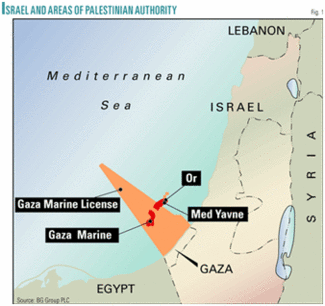
Michel Chossudovsky, "War and Natural Gas: The Israeli Invasion and Gaza's Offshore Gas Fields," Global Research, Janary 8, 2009.


The military invasion of the Gaza Strip by Israeli Forces bears a direct relation to the control and ownership of strategic offshore gas reserves.

This is a war of conquest. Discovered in 2000, there are extensive gas reserves off the Gaza coastline.

  ...negotiations with British Gas were conducted by the Ehud Olmert government with the knowledge that a military invasion was on the drawing board.

British Gas (BG Group) and its partner, the Athens based Consolidated Contractors International Company (CCC) owned by Lebanon's Sabbagh and Koury families, were granted oil and gas exploration rights in a 25 year agreement signed in November 1999 with the Palestinian Authority.

Read the rest here=>
Recommend this Post


More =>

Sphere: Related Content

Thursday, February 05, 2009

Saed Bannoura, "Egyptian blogs: Tents in desert reveal Israeli plan to transfer Gazans to Egypt," IMEMC News, January 20, 2009.


After flattening many parts of Gaza with aerial bombardment and ground artillery, Israel may be planning to transfer the now homeless refugees to Egypt, where hundreds of tents have been set up near Rafah. One local blogger said that a soldier told him there are many more tents being prepared, as well.

According to Professor As'ad AbuKhalil, author of the 'Angry Arab' blog, fellow blogger Ahdaf Souif in (Egyptian) Rafah told him, "Outside the general Hospital in Egyptian Rafah a city of tents has sprung up. I counted 200. But the soldiers there told me they have many more and can set them up immediately. They said the beds and furnishings for all the camps are ready. I was also told that other camps are being set up, in el-Arish and other locations. I was told these camps were being set up for 'the Palestinian refugees.'”

  Palestinians in Gaza, many of whom are the children or grandchildren refugees from what is now Israel, who were forced out when Israel was created in 1948 on Palestinian land, may be hesitant to move to what are currently temporary shelters in Egypt, but could end up becoming refugee camps – as the Gaza Strip became for 1948 refugees.

Israeli rightists have, in the past, promoted a plan to deny the Palestinian people a state by making Gaza part of Egypt, and the West Bank (minus the Israeli settlements) part of Jordan. Avigdor Lieberman, one of the most outspoken proponents of such a plan, is currently a member of the Israeli cabinet.

Egyptian officials have not commented on the tents, which were apparently set up after secret negotiations with Israel just prior to the Israeli 'ceasefire' in Gaza. Despite the 'ceasefire', Egyptian officials continue to make it extremely difficult for foreign nationals, including doctors and journalists, from entering Gaza through the Rafah border crossing.

Souif reported that he asked the Egyptian soldiers about the tents, and was told they were for Palestinian refugees who were expected to be coming through the Rafah border crossing when it opened. The Israeli government has been pressuring Egypt to open the Rafah crossing, while continuing to keep all other borders of Gaza completely sealed.

Palestinians in Gaza, many of whom are the children or grandchildren refugees from what is now Israel, who were forced out when Israel was created in 1948 on Palestinian land, may be hesitant to move to what are currently temporary shelters in Egypt, but could end up becoming refugee camps – as the Gaza Strip became for 1948 refugees.

But faced with a severe shortage of all essential items, the inability to rebuild homes flattened by Israeli forces due to the Israeli economic blockade preventing the entry of building materials and tools, many Gazans may not have much choice.

Many Arab bloggers are beginning to speculate that perhaps the transfer of the Gazans was, at least in part, Israel's main intention in invading the Gaza Strip for the last three weeks.

Read the rest here =>
Recommend this Post


More =>

Sphere: Related Content

Monday, February 02, 2009

Yacov Ben Efrat, "Israel and Hamas Won, So Who Lost?" Challenge Magazine, January 28, 2009.

  The media devoted its full power to nurturing the consensus, covering the war with unprecedented bias.


The spectacle of tanks back from the battlefield with the blue and white Star of David flapping from their turrets, the faces of the young soldiers, their body language—all leave no doubt concerning Israel's victory. If we compare this pullback from Gaza with the one from Lebanon over two years past, there is no need for extensive commentary: Israel has retrieved the pride and reputation of its army, which had been badly damaged by that other war in the north. The world has been reminded that the Middle East contains but a single military power worthy of the name. Deterrent capability, the magical force that is supposed to protect Israel from its enemies, has returned in full strength. Israel's Prime Minister, Ehud Olmert, who promised to correct his earlier failures in accordance with the findings of the Winograd Inquiry, has indeed come through.

The dry statistics show the same picture. The ratio of death in the Gaza operation was 1:100! The number of Palestinian losses, 1300 including 300 children, the flattened neighborhoods, the destroyed institutions, are just the immediately visible features of an enormous humanitarian catastrophe. Unlike Israel's cities in the south, Gaza does not have a system of sirens or warnings. There is no Palestinian Homefront Command. There are no "secure rooms" in the buildings, rather hovels with tin roofs. Hamas declared that when Israeli ground forces entered the built-up areas, the Resistance would "turn Gaza into the army's graveyard," breaking its morale. This did not happen. The tanks avoided the booby-trapped roads, moving instead through rows of houses while shaving them down—a tactic to which Hamas had no answer.

[This article ignores the November 4 IDF raid now believed to have signalled the real end of the tahdiyya, and repeats the loaded oversimplification of events that Hamas "threw the PA out of Gaza." But it expresses a number of interesting ideas about the war: 1) "...Obama, will soon have to decide whether to continue cold-shouldering Hamas, as his predecessor did, or to join Sarkozy in supporting a unity government (NY Times January 22, 2009); 2) "Israel, for its part, shows signs of favoring internal Palestinian reconciliation" though the signs it mentions are far from convincing; and 3) "The Arab world is split in two. On one side stand Qatar, Syria, Iran and Hamas, on the other, the moderate states headed by Egypt and Saudi Arabia. Qatar attempted to hold an Arab summit at Doha, but Egypt torpedoed it. Instead, there was a limited meeting of the radical axis, including Hamas, President Ahmadinejad of Iran, and President Assad of Syria." -jlt]

Read the rest here =>
Recommend this Post


More =>

Sphere: Related Content

Friday, January 30, 2009

Matthew Clark, " Egypt slams Iran’s Hamas, Hezbollah connection," Christian Science Monitor's global news blog, January 28, 2009.

[I have been looking for documentation of the oft-repeated view that Hamas is a proxy of Iran. If this is true, I wonder why Iran doesn't send Hamas better rockets. Hezbollah had rockets that took out about one Merkava tank per day and nearly sank a state-of-the-art anti-missile frigate designed to defend against far more sophisticated enemies of NATO et al.

Hamas, on the other hand, has rockets that won't reliably hit a slow-moving toddler or even an old person. What kind of benefactor is that? Hezbollah was better armed, better trained, and had better intelligence than Hamas has had.

Well, it seems that the Iranian government has been asking the same questions. If nothing else, the Israeli tantrum has brought a nascent relationship out of the woodwork.

Yesterday, Al Jazeera's report on the Davos conference contained an insight into this thinking on the other side:

Asked about achieving peace in Gaza, Benjamin Netanyahu, the leader of Israel's Likud party who was attending the forum, swiftly turned his answer to Iran, which he said was in a "100-yard dash" to get nuclear weapons.

While he did not specify any planned military action, Netanyahu said if Iranian rulers were "neutralised", the danger posed to Israel and others by Hamas in Gaza and Hezbollah in south Lebanon would be reduced.

Netanyahu said the global financial meltdown was reversible but "what is not reversible is the acquisition of nuclear weapons by a fanatic radical regime".
-jlt]

  Across the Arab world the conflict continues to tear at the rift between factions that extol resistance to Israel and the Western-friendly autocracies and monarchies that rule in the region.
Nicholas Blanford
Christian Science Monitor

Play in your own sandbox.

That seems to be the message Egypt is delivering to Iran.

Egypt’s foreign minister, Ahmed Aboul Gheit, fired a verbal broadside against Iran, Hamas, and Hezbollah, on Wednesday, saying the three “worked together in the fighting over Gaza to provoke conflict in the Middle East,” reports Reuters.

“[They tried] to turn the region to confrontation in the interest of Iran, which is trying to use its cards to escape Western pressure … on the nuclear file,” Mr. Gheit said in an interview with Orbit satellite channel on Wednesday.

This comes one day after Iran summoned the head of Egypt’s interest section in Iran to protest the Egyptian government’s refusal to allow Iranian aid to pass through Egypt to Gaza.

But aid isn’t the only thing Iran is attempting to send to Gaza, according to numerous reports. “An Iranian freighter carrying weaponry for Hamas has been blocked by Egypt from entering the Suez Canal, amid concerns that Tehran is trying to supply the Palestinian militant group with missiles capable of striking Tel Aviv,” reports The Australian.

Read the whole post with useful links here =>
Recommend this Post


More =>

Sphere: Related Content

Thursday, January 29, 2009

"Stormy debate in Davos over Gaza," Al Jazeera, January 29, 2009.

[To get a sense of the meaning and importance of this unfortunate story, it is relevant to recall that Turkey was the first Muslim country to recognize Israel (March 28, 1949). More recently, Turkey allowed IDF and Israeli security forces to gather electronic intelligence on Syria and Iran from Turkey. Through NATO, the two countries engage in military exercises together. (Chossudosky Aug 6 06) In November, Washington Post columnist Charles Krauthammer expressed the view that if Israel were to attack Iran, it would do so using Turkish, not Iraqi, air space. He is also quoted as having said, "When Israel attacked the reactor in Syria, it went up the Mediterranean and through Turkish air space" (Press TV Nov 28 08). Many questions here. -jlt]

The Turkish prime minister has stormed out of a heated debate at the World Economic Forum in Davos over Israel's offensive in the Gaza Strip.

Recep Tayyip Erdogan walked out of the televised debate on Thursday, after the moderator refused to allow him to rebut the Israeli president's justification about the war that left about 1,300 Gazans dead.

  "We really do need to get people to dinner."
David Ignatius
Moderator

Read the rest here =>Recommend this Post


More =>

Sphere: Related Content

Joel Charny, "Sri Lanka: When the whole world isn't watching," AlertNet, January 28, 2009.

One of the harsh realities of the humanitarian field is that some crises capture public attention, while others do not. The patterns are rather rigid. Crises in Europe and the Middle East, especially Palestine, make headlines. Large-scale natural disasters, even in obscure places, attract interest due to the inherent human fascination with immense forces beyond our control. But crises due to “complex” political conflicts outside the zones of proven public engagement are doomed to obscurity, unless it rises to such a level that “genocide” (read “another Holocaust”) can be invoked.

As of January 27th, not even Relief Web was listing Sri Lanka as an on-going crisis on its home page.

The contrast between Gaza and Sri Lanka prompts these observations. In Gaza, despite restrictions on international humanitarian and media access imposed by the Israelis, the whole world was watching, counting the civilian casualties minute-by-minute, while the global debate swirled on the legitimacy of Israeli and Hamas conduct in the light of international humanitarian law. The conflict and the suffering that it engendered were daily front page news. Now, with at least a temporary halt in hostilities, assessments of the damage in Gaza will proceed and donors will pledge millions of dollars for the rebuilding process.

While Gaza was the world’s focus, a conflict that raises similar issues and challenges was proceeding in the Vanni region in the north of Sri Lanka. There, the Sri Lankan military is trying to deal the final death blow to the Liberation Tigers of Tamil Eelam, the guerilla movement that has been fighting for an independent state for the country’s Tamil minority in the northern part of the island. As in Gaza, civilians are trapped. Approximately 250,000 people are caught in the conflict zone, people who have already been displaced numerous times and have suffered from the perpetual difficulty of sustaining humanitarian assistance as the 25-year civil war has dragged on.

Read the rest here =>

Joel R Charny is vice president for policy with Refugees International, a Washington-based humanitarian advocacy organisation. He has extensive experience in Asia for RI, Oxfam America and the U.N. Development Programme. He has managed and assessed emergency response and post-conflict recovery programmes in Cambodia, Sri Lanka and Indonesia.Recommend this Post


More =>

Sphere: Related Content

Tuesday, January 27, 2009

Nidal al-Mughrabi and Alastair Macdonald, "Israeli soldier killed, Gaza truce breached," AlertNet/Reuters, January 27, 2009.

A member of Hamas security forces looks at the remains of spent ammunition and unexploded bombs. REUTERS/Ibraheem Abu Mustafa (GAZA)


* Israeli soldier killed in bomb attack on border

* Air strike wounds militant on motorcycle

* As envoy flies in, Obama says time "ripe" for peace

* Egypt sets date for talks on Palestinian schism

GAZA, Jan 27 (Reuters) - An Israeli soldier was killed by a bomb on the border with the Gaza Strip on Tuesday and troops then killed a palestinian,in violence that strained a ceasefire and left people in Gaza fearing further Israeli attacks.

  "I don't care who fired. Hamas controls Gaza and is responsible for everything that happens."
Tzipi Livni
Foreign Minister


Ten days after Israel halted a devastating, three-week air and ground offensive that killed 1,300 people in the enclave, neither the ruling Hamas Islamist movement nor its smaller allies claimed responsibility for the attack on the patrol.

But on the day that U.S. President Barack Obama's envoy arrived in the Middle East bearing a message that the "moment is ripe" for peace talks, Israeli leaders facing an election in two weeks promised voters they would hit back hard.

Read the rest here =>
Recommend this Post


More =>

Sphere: Related Content

Monday, January 26, 2009

"A 12-Month plan for Gaza," MADRE, January 19, 2009.

While the bombardment of Gaza is currently halted, the impact of a month of ceaseless violence against women and families is catastrophic. MADRE's sister organization, the Palestinian Medical Relief Society, has assessed the most critical needs of the population and prepared a detailed report on their immediate plans to address them. This section summarizes our partner's initial strategy:

Palestinian Medical Relief Society


A Population under Fire


Emergency Response to the Humanitarian Crisis Resulting from Large Scale Violence and Attacks Targeting the Gaza Strip


R4ad about the proposed activities here =>Recommend this Post


More =>

Sphere: Related Content

"Israel Vows to Back Soldiers Accused of War Crimes," Asharq Alawsat, January 26, 2009.

JERUSALEM, (AP) – Special legal teams will defend Israeli soldiers against potential war crimes charges stemming from civilian deaths in the Gaza Strip, the prime minister said Sunday, promising the country would fully back those who fought in the three-week offensive.

  "I do not know of any military that is more moral, fair and sensitive to civilians' lives"
Ehud Olmert


The move reflected growing concerns by Israel that officers could be subject to international prosecution, despite the army's claims that Hamas militants caused the civilian casualties by staging attacks from residential areas.

"The state of Israel will fully back those who acted on its behalf," Prime Minister Ehud Olmert said. "The soldiers and commanders who were sent on missions in Gaza must know that they are safe from various tribunals."

Speaking at the weekly Cabinet meeting, Olmert said Israel's justice minister would lead a team of senior officials to coordinate the legal defense of anyone involved in the offensive.

"That decision is not going to prevent all these organizations and countries to pursue their efforts through legal means," Palestinian Foreign Minister Riad Malki said at talks with European Union foreign ministers in Brussels. "So there is no immunity even if the decision was taken by the Israeli government."

Read the rest here =>
Recommend this Post


More =>

Sphere: Related Content

Saturday, January 24, 2009

Sami Awad, "Personal reflection on Gaza," Never Give Up, January 15, 2009.

n this period I did not take on an opportunity to travel to the peace research village in Tamera Portugal and be with a group of close friends that are engaging in a deep process to build what will be a Peace Research Village (PRV) in the Middle East…. For many reasons I was not able to travel, today I sent them the following reflection:

Dear beloved, dear community…

… I acknowledge that I am doing nothing and acknowledge that my presence here is not providing any relief to those in Gaza who are suffering or in the West Bank who are growing in hopelessness.

  I will not ask why? Why only creates more questions than answers… I will only ask: what can I do to create deep and real transformation in healing? Not only to heal the victim but the victimizer as well.

My presence here is mostly important for my internal development and growth and in preparing for the future, a future where real opportunities for peaceful coexistence based on equality are made available to all. Since this war on Gaza began, I have been in a deep process to distinguish my own emotions and reactions and even interpretations and identity from the reality, but more important it has been a process to distinguish the nails in my feet from my responsibilities for the future.

I hear and sense the pain and my heart breaks with the cry of every mother or father that lost a child or a child that lost a parent. At one point every time I saw a child from Gaza on television I saw the face of my daughters, Layaar or Larina.

Read Sami's whole letter, update and comments here =>
Recommend this Post


More =>

Sphere: Related Content

Friday, January 23, 2009

"Updated statement on the alleged use of DU in Gaza," International Coalition to Ban Uranium Weapons, January 22, 2009.

UN agencies to investigate alleged DU use in Gaza following concerns from Arab states.

  It is likely that high explosive and the controversial flechette rounds would have been used instead.

ICBUW broadly welcomes the decision by the IAEA, WHO and UNEP to investigate the alleged use of uranium weapons by Israel in Gaza after concerns were expressed by several Arab governments.

It appears that the response was triggered by media reports from Iranian Press TV and other regional outlets suggesting that uranium weapons had been used. These speculative reports contained little in the way of evidence to support these claims.

Read the rest and link to Channel 4 munitions package here =>
Recommend this Post


More =>

Sphere: Related Content