Masthead graphic based on a painting by Gudrun Thriemer.

Showing posts with label politics. Show all posts

Wednesday, May 20, 2009

Hannah Gilkes, "Interview: Meles Zenawi, Africa Confidential, Vol. 50, nol 10; May 3, 2009.

[About the international response to events in Somalia, Zenawi says, "there was not enough money to support the government, lots of promises but very little delivery. Secondly, whatever money was being delivered was being delivered by third-party organisations: NGOs, international organisations." The same is being said about Afghanistan. -jlt]

Africa Confidential: You’ve gone on record as saying that an effect of the financial downturn could be increased political unrest in Africa. That was three months ago. Is that point of view still valid and are there particular areas that you are more concerned about?

Meles Zenawi: Well, soon after I said that, in the context of preparation for the G-20 summit, I got in touch with a number of African leaders and my worst fears were confirmed. The President of Liberia [Ellen Johnson-Sirleaf] was in a preparatory meeting for the summit and she said that one of the sources of instability in Liberia has been the very high rate of unemployment among the youth and the fragile peace that they have in Liberia was too fragile for it to withstand massive layoffs among the youth; and that is what she feared would happen as much of the investment that they had been promised had simply disappeared.

Later on, the President of Southern Sudan and Vice-President of Sudan [Salva Kiir Mayardit] got in touch with me and indicated to me that because oil prices had collapsed and because oil was the primary source of revenue for his government, he may not be able to pay the salaries of his armed men and he felt that that was a rather dangerous thing to do. And, thirdly, in the DRC [Congo-Kinshasa], I heard reports that in the mining areas of the country, which are the most economically vibrant areas of the DRC, something like 300,000 people had been laid off since the recession began. That is 300,000 mostly young people who are no longer employed and that is a very dangerous thing in an environment of a very fragile peace. So I think that while, initially, that appeared to be a sort of pessimistic assessment of what could happen, since then it appears that that prognosis was not all that pessimistic.

Read the rest here =>
Recommend this Post


More =>

Sphere: Related Content

Saturday, May 16, 2009

B. Raman, "India: Elections and after," Chennai Centre for China Studies, May 16, 2009.

[No doubt many will find something to disagree with here; however, Raman's analysis of the Indian election touches on a broad range of issues and provides a brief introduction to the political scene in India today. -jlt]

While the official results in the elections to the Lok Sabha, the lower House of the Indian Parliament, are yet to be announced, it is clear that the Congress (I) has not only retained its position as the largest single party, but has even improved its position as compared to the results of the 2004 elections by about 50 seats. The parties, which belonged to the United Progressive Alliance (UPA), as the coalition led by it is known, are well set to have a near absolute majority— more than 50 per cent of the total seats— if not an absolute majority. This should enable the Congress to form a coalition Government headed by Dr.Manmohan Singh as the Prime Minister once again for five years. There is likely to be greater ideological cohesion in the new Coalition and this should enable the new Government to give a fresh momentum to the implementation of much-needed economic reforms. Under the departing Government, also led by Manmohan Singh, the lack of an ideological cohesion stood in the way of such implementation.

2. There has to be a caveat here. The Trinamool Congress (TC) of Ms.Mamta Banerjee, which has a won a remarkable victory in West Bengal and which will be an important member of the new coalition, has its own retrograde baggage in economic matters— such as its unrelenting opposition to special economic zones and its allergy to corporate houses. This baggage might come in the way of the needed economic reforms if the Prime Minister and Mrs.Sonia Gandhi, the leader of the Congress (I), are unable to persuade her to bury her economic baggage.

  How to meet the expectations of the corporate world without sacrificing the interests of the common man? How to meet the expectations of the common man without sacrificing the needs of the corporate world?

Read the rest here =>Recommend this Post


More =>

Sphere: Related Content

Sunday, April 26, 2009

Karin Friedemann, "Islamophobia on American campuses," Letter from America/Khaleej Times, April 26, 2009.

Muslim parents from around the world once sent their children off to school in America with simple warnings against wine and song, but now Muslim students must be prepared to face Islamophobic incitement.

While political activism makes college exciting, Muslims need to be aware that autonomously managed local Muslim Student Association university chapters are outclassed by well-funded, hierarchically coordinated Jewish and Neoconservative organisations, which actively work to undermine Muslim student groups.

The Jewish Anti-Defamation League, which blacklists professors for failure to teach the Zionist version of the Israeli-Palestinian conflict, labels MSA an “Anti-Israel” organisation and keeps detailed files on its activities.

Steve Emerson’s Terrorism Awareness Project published a “Student’s Guide to Stop the Jihad on Campus” manual for organising “Islam-Fascism Awareness Week,” whose stated goal is “to show the connections between the MSA and the international jihad.”

  The Jewish Organisation of America in consultation with Hillel sued Michigan State University for permitting Muslim students to wear graduation stoles inscribed with the Shahada.

Read the rest here =>Recommend this Post


More =>

Sphere: Related Content

Friday, April 10, 2009

Johann Rossouw, "South Africa's last chance," Le Monde diplomatique, March 25, 2009.

On 22 April South Africa will hold its third parliamentary elections and will have a new president. It may be the country’s last chance to stop the erosion of democracy through parliamentary means

Every year in December and January — the summer holidays — South Africa practically comes to a standstill. The small but growing middle class head for the country’s glorious beaches; poorer people join the exodus from the cities to visit family in the rural areas.

This year, as people returned from holiday, they were greeted outside cities with a huge billboard filled with the massive smiling face of Jacob Zuma. Zuma is a man who tells different factions what they want to hear, but whose real positions are still unclear; he is also likely to be South Africa’s next president.

  While SA has been able to achieve consistent growth in GDP of 3% or higher for most years since 1994 (largely due to high commodity prices up to 2008), the country fell in the UN Human Development Index from position 89 in 1998 to position 125 in 2008.
Author

Read the rest here =>Recommend this Post


More =>

Sphere: Related Content

Friday, February 20, 2009

Dan Williams, "Netanyahu handed reins of a jittery Israel," AlertNet/Reuters, February 20, 2009.

Bibi's back.

A decade after being ousted by Israelis entranced by his then rival's pledges of peace accords and modest governance, Benjamin Netanyahu has won a new lease on power over a country now more given to disaffection and fears of war.

President Shimon Peres on Friday handed him a mandate to form Israel's next government, and the right-wing Likud leader now has 42 days to put together a coalition. He should manage that with like-minded allies, even if his appeal to centrist and left-wing rivals for a unity government falls on deaf ears.

  The U.S.-educated son of an noted Zionist historian, Netanyahu, 59, cast his comeback as vindication of the Likud's long view -- that ceding occupied Arab land unilaterally had backfired by encouraging Islamist foes of the Jewish state.

Read the rest of this background piece here =>Recommend this Post


More =>

Sphere: Related Content

Sunday, February 15, 2009

A brief reflection on solidarity

"The dawning realization of many citizenries that we are being subjected to an aggressive assertion of jurisdictional authority we had no hand in creating or shaping replicates and further globalizes the long experiences of Indigenous peoples" (Hall 120).

Recommend this Post


More =>

Sphere: Related Content

Friday, January 23, 2009

A.G. Noorani, "Anti-politics machine," Frontline, Volume 26, Issue 02, January 17-30, 2009

Neither politics nor the politician deserves sweeping censure. Such censure is an abdication of public duty.

  Be it a sports club or a women’s organisation, the ghost of politics will stalk its floors because conflicting interests exist within its domain.

“POLITICS is a preoccupation of free men, and its existence is a test of freedom.” It is too much to expect people who went on television to grab whatever publicity they could, in the wake of the terrorist strikes in Mumbai, to read Professor Bernard Crick’s mini-classic In Defence of Politics, or, for that matter, any serious work that bears on the subject. The anchors who invited them were of the same class. The people, exasperated at the lapses of the state, understandably responded to the shrill, sweeping denunciation of politicians and politics. They could not be expected to recall that the loudest among the member panelists was an ardent supporter of Indira Gandhi and the dictatorship she imposed on India.

The chatterati who decry politics are rank hypocrites. They themselves practise politics all the time – in Bar associations, sports bodies, women’s organisations, and wherever their own interests are at stake, in their offices and outside. In this, they will freely take the help of politicians, of course. Totally absent is the slightest effort to understand what politics is about; how and why it is debased; its relationship to the quality of politicians and to the temper of the people; the claims that can legitimately be made on those who practise the craft; and, not least, the limits of political action and the constraints of morality in the political process. In short, a serious, informed discourse.

Read the rest here =>
Recommend this Post


More =>

Sphere: Related Content

Saturday, December 06, 2008

Sam Logan, "Beijing's Latin America inroads," ISN Security Watch, December 4, 2008.

  Countries that replace a dependence on trade with the US with a dependence on China, however, should be aware of China's own economic troubles, banking sector weaknesses, and ultimately the Communist Party's sense of self preservation.

The Bank of China will open its first office in Brazil in March 2009, marking Brazil's importance to China in growing Sino-Latin American relations, according to a 28 November report in China's official newspaper, the China Daily.

The results of the recently concluded Asian-Pacific Economic Council (APEC) summit in Lima, Peru, show that Brazil is not the only country important for China in Latin America. In fact, compared to the 2004 APEC summit held in Santiago, Chile, China's growing presence in Latin America shows a determined, focused and well planned approach centered on trade, political ties and Chinese energy security.

In 2004, Chinese leader Hu Jintao made a very public tour of Latin America, promising US$100 billion in trade by 2010 on the heels of the APEC summit in Chile. His promise was reached in 2007, with trade between China and Latin America passing some US$102 billion and bilateral trade between China and Brazil around US$23.37 billion, according to China's Ministry of Development, Industry and Foreign Trade (MDIC).

China has inked a free trade agreement (FTA) with Chile and Peru, and negotiations for an FTA with Costa Rica are underway.

Read the rest here =>
Recommend this Post


More =>

Sphere: Related Content

Thursday, November 27, 2008

Paolo Moiola interviews Frei Betto, “I am still convinced that capitalism is incompatible with human rights,” November 7, 2008.

  Chávez could be a not-so-friendly person, but there is no doubt that he has won eight democratic elections. And he respected the decision of the people when he lost...

In the first part of this interview Brazilian theologian Carlos Livanio Christo, a priest better known as Frei Betto, spoke about his long experience with Brazilian President Luiz Inácio Lula da Silva and his government. Here, Frei Betto talks to Latinamerica Press collaborator Paolo Moiola about Colombia, Venezuela and Latin America as a whole, and about the situation facing Liberation Theology and the Catholic Church in the region.

How do you see the situation in Latin America?
I´m very optimistic. We are seeing our best moment for Latin American integration. We have Mercosur [the Southern Common Market] and ALBA [the Bolivarian Alternative of the Americas, created as a response to the failed US proposal, Free Trade Agreement of the Americas]. No one gives any importance to the Organization of American States.

For a few years, people have been talking about Latin America´s “democratic Spring.” What do you think about it?
Over the last 40 years, we have seen three periods: military dictatorships, neo-liberal governments and, now, popular democratic governments.

Read the rest of Part II here =>

Part I is available here =>
Recommend this Post


More =>

Sphere: Related Content

Wednesday, March 05, 2008

International Women's Day meditation: Secularism, fundamentalism, church and state

My father was the intellectual in our family. So my mother's answer was as memorable as it was surprising one bright spring morning when she turned someone away from our door who was soliciting for a church--and I asked her why.

I don't remember whether they were raising money for charity or seeking to convert us. But I do remember her answer. She explained in a public vocabulary that was not her natural manner of speech that it was because of the separation of church and state. Jesus, she said, had not gone from door to door. He had said, "Render unto Caesar that which is Caesar's and unto God that which is God's." And that was the way she figured it ought to be.

Why do I think of that now?

Maybe it's because an amendment to the 500-page Income Tax bill passed last fall and now before Canada's Senate moved onto center stage of public debate this last week. That amendment, which some attribute to the Christian right, would allow our government after the fact to deny tax breaks to films it deems, in its wisdom, to be quote "contrary to public policy." (Toronto Star Mar 2 08)

Maybe it's because International Women's Day comes again in a few days, and I've been thinking about my mother.

Maybe it's because Charles Jeanes host of CJLY's History's Hour was on about fundamentalism, secularism and , consciousness this week.

He cites a review in January's Harper's magazine by John Gray of a book by Canadian political philosopher. Charles Taylor, called A Secular Age and asks this:


"If societies become less religious as they become more modern, how is it that the United States, which sees itself and is seen by others as the epitome of a modern country with the separation of church and state enshrined in the constitution, remains as religious at the start of the 21st century as it was in the early part of the 19th century, at which time Alexis de Tocqueville noted the intense religiosity of American life. How can this be? Is America an anomaly among advanced societies? or is the theory of secularization flawed? If the power of religion can be limited by a secular state, why does religious fundamentalism play a larger role in American political life than it does in the political life of any other developed country?"


Separation of church and state is important today because of the “Christian” part of the new conservative incarnation on one side and political islam on the other side of an explosive dualism.

There are at least two versions of secularism. One comes from Marxism. Marx said, "Religion is the opiate of the people." These are Senator McCarthy's “godless communists,” religious rejectionists. For them, separation of church and state doesn't apply. Church is simply rejected. The state became the religion.

A second type of secularism is what I want to explain to Charles. It's a non-sectarian secularism. Conservatives confuse it with moral relativism. In the US, the separation of church and state is mandated by the Bill of Rights. In personal terms, it means a sanitized public language. There is no prayer in public school. Religion not taught in publicly funded schools. For a long time, people did not refer to God or the gods or any form of divinity or supreme being in public discourse. David A. Fowler.

I think what Charles Jeanes and Charles Taylor both miss about secularism and religion in the United States is its connection with religious freedom. What happened long before the disappearance of "spirits" from the natural world in Europe was the multiplication of protestant religions there, beginning probably some time between Dante (Divine Comedy pub 1321), which shows selected Popes in Hell, and the death of Chaucer (1400), whose anti-clerical portrait of the pardoner and the summoner are well known. The roots of Protestantism are in the anti-clerical literature of that period. In establishing the Anglican Church, Henry VIII put icing on a cake that already included several western popes (one in Rome and another in Avignon), some important reformers (Hus and Wycliffe), and a growing literature of dissent--but not much outright atheism. Wycliffe wrote against papal encroachments on secular power.

When we talk today about the American Empire, we should probably remember that it is a variation of European empires for which the initial vanguard was often the Church.

Unlike other colonial undertakings, the eventual US was made up of non-Catholic believers of numerous varieties (who usually thought themselves holier than their Catholic counterparts). They sought legitimacy for themselves and eventually came to understand that they could only have it by joining other dissenters who differed from one another far more than they did from Rome. So they made a public show of ignoring their theological differences in order to affirm their common political need for space (and land which they were stealing from the newly discovered nations of North America).

The solution was a separation of church and state mandated in the US Constitution. It was a separation the seeds of which did exist during the middle ages when it was debated and invoked as a principle of convenience. However, in the US, the divide was enlarged and enshrined as a fundamental principle of American (archetypal) democracy. Thomas Jefferson once referred to it as the "wall of separation." It is often presented as a principle of the Englightenment or even science. But it is really an accommodation that made religious freedom possible in a more divers context than any single polity I know of with the possible exception of India.

Then Christian conservatives found a voice. Stephen Zunes explained the process in a perceptive article several years ago:
"Traditionally, US fundamentalist Protestants were not particularly active in national politics, long seen as worldly and corrupt. This changed in the late 1970s as part of a calculated effort by conservative Republican operatives who recognized that as long as the Republican Party was primarily identified with militaristic foreign policies and economic proposals that favored the wealthy, it would remain a minority party. Over the previous five decades, Republicans had won only four out of 12 presidential elections and had controlled Congress for only two of its 24 sessions.

"By mobilizing rightist religious leaders and adopting conservative positions on highly charged social issues such as women's rights, abortion, sex education and homosexuality [and calling them ‘family values.’ Isn’t birth control in there too? These are the guys who promote abstinence as the only interpretation of ‘safe sex.’ And would you call these conservative positions or reactionary ones--reactive in the sense of hysterical, and reactionary in the sense of responding to issues that have already been put on the table by someone else. Reactionary and appropriationist. Is the idea that the family will be better off if we are able to use the law and social pressure to coerce people who are gay into traditional heterosexual marriages? -jlt], Republican strategists were able to bring millions of fundamentalist Christians - who as a result of their lower-than-average income were not otherwise inclined to vote Republican - into their party. Through such organizations as the Moral Majority and the Christian Coalition, the Republicans promoted a right-wing political agenda through radio and television broadcasts as well as from the pulpit. Since capturing this pivotal constituency, Republicans have won four out of six presidential races, have dominated the Senate for seven out of 12 sessions, and have controlled the House of Representatives for the past decade" (Zunes Christian right Jul 14 04).


Now the American Christian right, which is sometimes (I think) incorrectly called fundamentalist or evangelical, has invented/discovered a language (and a confidence in its territorial claims and in the elimination of the threat from "merciles Indian savages" as the were called in the Declaration of Independence). This new way of speaking and confidence in its territorial claims allows for a coming out of some Christian elements, sometimes to ignore the biblical divide between God and Caesar. They rail against secularism (identified conveniently with Marxist atheism) and call themselves "Christians"--not Methodists or Baptists or Presbyterians etc. I frequently had students come up to me after the first class of the term and introduce themselves, somewhat belligerently, saying "I'm a Christian."

Later, when I could question them in more detail, it was clear that they did not see the Pope as "a Christian" in this sense. Christians who still believed in the separation of Church and state they described contemptuously as "secular liberals" or some similar deligitimizing formulation. Democracy (modernity) was established in the US to make room for religious diversity. Remember, Ferdinand and Isabella, consolidated their monarchy by evicting both the Moorish Muslims and Sephardic Jews from Spain in the same year they commissioned Columbus to discover a route to India. That failed mission allowed them to export the Inquisition to Mexico and Peru in 1521. Early American Puritans experimented with witch-burning but gave it up to focus their genocidal energies on the Indians.

The same impulse found expression from time to time--in thousands of lynchings (mostly of blacks) during the period of western expansion, in the McCarthy "witchhunts", and now in the crusade of neoliberal conservatives, authoritarian reform Christians, and the paramilitary right against political Islam. It's odd for me. One of the features of Christianity that I respect the most is its foundational commitment to grassroots political issues. As I learn more about it, I realize that Buddhists and Hindus sometimes get forced into social issues. But for Christians--and as it turns out Jews and Muslims--social justice, justice in the real world and not just the hereafter, not just as a feature of some spiritualized abstraction--is a central feature of the original teachings.

But the "Christians" we are struggling with now are the ones who, in the Middle Ages, wanted tougher punishments for the sins of reform, more absolute authoritarianism, more militant crusades against the infidels. I often think that we are fortunate to live in a time when these people have not yet joined with their natural allies--the other self-righteous religious bullies in Islam, Judaism and among scientific marxist totalitarians.

If we don't want to be bullied by them, we will need a robust version of secularism strengthened by clear thinking and vigorous public debate.


Creative Commons License


This article is published by James Terral under a Creative Commons licence. You may republish it free of charge, wholly or in part, with attribution and for non-commercial purposes following these guidelines. Commercial media must contact World Report worldreport (at) cjly dot net for permission and fees. Some postings on this site are published under different terms.


For example, this site contains copyrighted material the use of which has not always been specifically authorized by the copyright owner. World Report makes this material available in order to advance understanding of the issues by reporting, reviewing, and criticizing relevant public statements.

Canada's Copyright Act specifies in sections 29.1-29.3 that “fair dealing for the purpose of criticism, review, or news reporting does not infringe copyright if the following are mentioned:
(a) the source; and
(b) if given in the source, the name of the
(i) author, in the case of a work,
(ii) performer, in the case of a performer's performance,
(iii) maker, in the case of a sound recording, or
(iv)broadcaster, in the case of a communication signal.
Recommend this Post


More =>

Sphere: Related Content
Friday, February 08, 2008

The largest discussion on homelessness and poverty in Canada marks 6 years, CKUT (Montreal)

poster

This year's Homelessness Marathon will broadcast live from the streets of Montreal on Wednesday, February 20th, starting at sunset and running all night long until sunrise on Thursday, February 21st.

What is the Homelessness Marathon?

The sixth annual Homelessness Marathon will once again serve up 14-hours of people-powered radio, broadcasting from outside of the Native Friendship Center of Montreal (St. Laurent & Ontario) beginning at sunset. With the goal of being a consciousness-raising event, the Marathon will provide an opportunity for homeless people & their supporters to take to the airwaves, and allow a nationwide discussion on homelessness issues and possible solutions. The Homelessness Marathon is annually carried by more than 30 radio stations. Listeners are invited to call-in with their questions or comments toll-free at 1.866.763.4136.

2008 Topics

Set to broadcast WED February 20th, 5pm (EST)

:: HOUR/HEURE 1, 5pm / 17h - Homelessness by Numbers / L'itinérance en chiffres

:: HOUR/HEURE 2, 6pm / 18h - Disabilities in the streets / Être sans-abri avec un handicap physique

:: HOUR/HEURE 3, 7pm / 19h - Indigenous Hour / L'Heure autochtone

:: HOUR/HEURE 4, 8pm / 20h - Les réfugiéEs dans la rue / Refugees and homelessness

:: HOUR/HEURE 5, 9pm / 21h - A critical look at services / Un regard critiques sur les services communautaires

:: HOUR/HEURE 6, 10pm / 22h - Poverty on the move - from downtown to the suburbs / La chasse aux pauvres, du centre-ville aux quartiers aux banlieues

:: HOUR/HEURE 7, 11pm / 23h - theater in the streets / Théâtre dans la rue

:: HOUR/HEURE 8, Midnight / Minuit - OPEN MIC Rants, Poetry, and Music on the Streets / MICRO OUVERT Declamations, chialage, poésie et musique sur la rue avec/with CKUTs Off the Hook

:: HOUR/HEURE 9, 1am / 01h - Policing poverty / Judiciarisation de la pauvreté

:: HOUR/HEURE 10, 2am / 02h - racisme et pauvreté dans la rue / racism and poverty in the street

:: HOUR/HEURE 11, 3am / 03h - literacy and education in the streets / analphabétisme et éducation dans la rue

:: HOUR/HEURE 12, 4am / 04h - Homelessness and working / Travailler et vivre dans la rue

:: HOUR/HEURE 13, 5am / 05h - Physical and Mental Health on the Street / La santé mentale et physique dans la rue

:: HOUR/HEURE 14, 6am / 06h - homeless nation hour of power / L'heure du pouvoir

For more information, contact

(Français) Sophie Vaillancourt, 514.448.4041 x6788
(English) Gretchen King, 514.448.4041 x6788
Recommend this Post


More =>

Sphere: Related Content

Saturday, December 08, 2007

Crow and kitten


Moreover, they play, have a sense of humour, and communicate. What does this say about nurture and nature? About the invevitability of war (because it is human nature)? About the souls of animals?

Recommend this Post


More =>

Sphere: Related Content

Wednesday, September 12, 2007

FEATURE
"A year in context, part 1/2: Is it the end of the world?" September 11, 2007.

Back in 1969, I had a gig as a photographer on a project that produced a preliminary scan of pollution along the Fraser River. We stopped at communities along the way—Abbotsford, Hope, Lytton, Lillooet, Quesnel, Williams Lake. When we got to Prince George, our host took us down to a sandy spot at the side of the river.

We sat down and made ourselves comfortable. It was the end of a long day. He lit up a joint, and as he reached it slowly in my direction, said, “So, is it the end of the world?”

Looking back over the last year, the main theme of World Report has been multipolar realignment, the return of a multinational world order.

Multipolar realignment is a shift, real or anticipated, from a world order dominated by the “sole remaining superpower” to one in which leadership must be shared. It is—or would be--a new balance of power.

Is it really happening? What does it or will it or is it likely to look like? As an end point, a multipolar world order would be one in which no single state was able to achieve (or impose) its will without the cooperation of the other powers.

The defining dynamic of a shift to such an order would be a decline in the effectiveness of the “sole remaining superpower” accompanied by an increase in the power of one or more nations or groups.

We would expect this realignment, if it is happening at all, to proceed in the manner of a hiistorical evolution. It's progress would be ragged and uncertain. For every eight steps taken in one direction, seven will go in the other, with some events too ambiguous to interpret one way or the other.

I have some biases I should be clear about. Two years ago, I said that the term “superpower” is “borderline gibberish.”

I said that in 2003,

“Everyone, including the President, whose public speech is heavily laced with such linguistic junk food, called the US 'the world's only superpower.' People all across the political spectrum asked what country was next on America's hit list, as if nothing could prevail over US military might.

It was a delusion. But it was, in those days, a very common delusion.”


In my opinion, the President's use of language hasn't improved in the last four years. But the number of people who share the delusion that a big, expensive army is invincible seems to be declining.

By 2005, with the mission still not accomplished, the perception was beginning to take root “that Washington could be opposed effectively without incurring unacceptable costs" (Weinstein and Bendersky Realignment Jun 20 05).

This inevitably led to whispers that Uncle Sam's ability to become “the unquestioned political and military arbiter of the globalizing world economy” was less than you might expect from such an amazing collection of military hardware.

Indeed, the status of the US as the world's sole remaining superpower comes from three sources: military, economic and political dominance.

Viewed in this way, one of the most important events of the last twelve months was the Chinese test of an anti-satellite weapon in January. The test brought the possibility of asymmetrical warfare to outer space, a special worry to Americans and Canadians who believe that space has not already been “weaponized.”

According to John Pike, a satellite expert at globalsecurity.org, "Our space assets are the first asset on the scene....

"They are absolutely central to why we are a superpower; a signature component to America's style of warfare" (qtd Brooks Bulletin Jan 18 07).

But the trouble had started before that. By this time last year, the official cessation of hostilities in the Lebanon war (July 12 to August 14) had taken place nearly a month before on August 14, 2006. Here was yet another war that appeared to demonstrate that an army could establish full spectrum dominance, and still lose the more important political war both abroad and at home.

The collapse of domestic support for Israeli PM Ehud Olmert was certainly striking. But much bigger surprises came from Fouad Siniora, the Lebanese Prime Minister.

Siniora is a strong supporter of the western influence in Lebanon and is even described by some as a puppet of America. But as President Bush found out last month when Hamid Karzai described Iran as “a helper and a solution” indeed as “a supporter of Afghanistan, in the peace process that we have and the fight against terror and the fight against narcotics in Afghanistan" the puppets seem to be acquiring minds of their own.

In a series of press conferences during the war in Lebanon, Siniora repeatedly called attention to the Palestinian refugees' right of return. He also repeated that sooner or later Israel would have to establish friendly relations with its neighbours and one time expressed the view that Lebanon would be the last Arab state to recognize Israel.

In Afghanistan, all three pillars of American dominance—military, economic and political—are on the line. More, the future of NATO is in question. Former Indian diplomat to the region M K Bhadrakumar observes
“it was apparent to anyone that the North Atlantic Treaty Organization was a divided house and that the United States' old European allies didn't share its apparent intention to turn Afghanistan into a client state under a NATO flag from where US power projection into the Persian Gulf and the Middle East and South Asia and Central Asia would become possible” (ATol May 19 07).


By this time last year, it was clear that the Taliban, which had been driven from the field in 2002, was back in force.

Last year was the worst for Canadian troops, and it seemed that 2007 might be even worse yet. That hasn't turned out to be the case. Canadian casualties for 2007 are slightly lower than for 2006. The Taliban's spring offensive that was talked about all winter didn't materialize.

Even so, we do not appear to feel threatened by the Taliban. For whatever reason, the reconstruction of Afghanistan has not gained traction with Canadians as a great national project.

Nagging NATO didn't put any more troops in the field either.

Bhadrakumar again: quote

“There is an Afghan opinion building up over the imperative of an intra-Afghan dialogue leading to genuine power-sharing. But the US and NATO pretend they aren't seeing the groundswell of opinion.

Their emphasis is on the existential challenge posed by [the] Afghan war to NATO's global role. They look over the Afghan ridge toward the new cold-war horizon. Meanwhile, the US is inexorably losing its monopoly over conflict resolution in Afghanistan. And regional powers include some that are against the open-ended presence of NATO forces.”


Blaming Pakistan has shaken Musharraf's hold on power, but it doesn't appear to have made Pakistanis glad at the prospect of Americans flying missions into their country.

In fact, the whole matter of air support for NATO forces has been identified as the main cause of the increase in civilian casualties inflicted by NATO forces.

The economic source of the US status as the world's sole superpower is scarcely more secure than the military one. In October, former Chief Economist and Senior Vice President of the World Bank delivered a 700-page report that called climate change "the greatest and widest ranging market failure ever seen" (Oct 30 06).

A few days later, a study published in Science magazine concluded that at the rate species were being lost there would be no more viable fish or invertebrate species available to fisheries by 2050. Another market failure requiring intervention since the results also showed that these trends are still reversible.

Economic dominance of institutions like the IMF and the World Bank are in decline because China and Venezuela have emerged as alternate sources of development funding.

Cold War analysts keen to see the Shanghai Cooperation Organization as a new version of the Warsaw Pact have seized on joint military exercizes and the presence of Iran as key features. But it's more complex than that and we're getting short of time. Suffice it to say for the moment that the SCO is another alternate source of funding and energy cooperation for countries of the region.

The WTO negotiations known as the Doha Round are also in trouble. Whether you think all this superpower in decline stuff is bad news or good, there have been some developments that run in the other direction that might make a good starting point for next week.

So is that the end of the world? Maybe not. My Prince George friend and I were not ready to embrace a secular version of the apocalypse, until after we had examined a few other catastrophes of varying scope—say the collapse of the Soviet Union, the Great Depression, and the Fall of the Roman Empire.

Get the podcast.


Creative Commons License


This work is licensed under a
Creative Commons Licence.

Recommend this Post


More =>

Sphere: Related Content

Sunday, July 15, 2007

FEATURE
"Political options in Afghanistan, part 1 of 2" July 16, 2007.

On Jul 09 07 WoRpt we looked at how the American and Canadian media have reported on the military option in Iraq. Today we look at the political option.

It may come as a surprise that the Dutch-Israeli military historian, Martin van Creveld has provided us with a useful framework for this discussion in his new book, The Changing Face of War, published by Random House but not available until January 2008.

Probably best known for his groundbreaking book The Transformation of War (1991), van Creveld provides a summary in this latest work of what a state must do to prevail over non-state forces like the Taliban.

The book's 6th chapter examines one of the few cases where the state's armed forces have been successful, the British Army in Northern Ireland.

In van Creveld's words,

First, unlike President Bush in 2001, the British did not declare war, which would have removed a whole series of legal constraints and put the entire conflict on a new footing. Instead, from beginning to end the problem was treated as a criminal one…

In his review of van Creveld's new work, William Lind, an American military historian who, like van Creveld specializes in how to deal with non-state or so-called terrorist forces, comments that quote “in contrast to what we hear from the Bush administration and the U.S. military, van Creveld sees the removal of restrictions on what troops can do as a disadvantage. He understands that in Fourth Generation war, the counter-intuitive is often correct.”

Treating a non-state threat as a criminal problem rather than a military one suggests an entirely different way of thinking—one that gets out of the “with us or with the terrorists” straightjacket and opens the door to a whole range of non-military or political solutions.

At year's end, I was working on a piece that proposed half-a-dozen non-military solutions for Afghanistan. These were not hypothetical notions spun from airy nothing while I sat in my easy chair watching the grass grow.

As you will see, each was sponsored by organizations and individuals with as much credibility as anyone still has on this issue.

I repeat them but briefly here, and return to van Creveld's other observations--not because these political options are every bit as good as they were in January, but to give a succinct indication of just how rapidly the situation in Afghanistan has deteriorated in about half-a-year.

The first political option was to deal with crimes of the past and to exclude so-called undesirable elements from government, remove corrupt officials.

Following conclusion of the Bonn process, which created the country’s elected bodies, the Afghan government and the so-called international community committed at the London Conference (31 January-1 February 2006) to a document called the Afghanistan Compact.

Both the Afghan government and those present at the London Conference committed to an Action Plan on Peace, Justice and Reconciliation. The purpose of this plan was to rebuild trust among those whose lives had been shattered by war and to reinforce, in the words of the Compact “a shared sense of citizenship and a culture of tolerance, pluralism and observance of the rule of law.”

The players anticipated a legal process--trials perhaps--possibly a truth and reconciliation body such as was pioneered at the end of Apartheid in South Africa. In November 2006, the International Crisis Group urged the government of Afghanistan to “press ahead” with it “accounting for all eras from the communists to the Taliban.” Human Rights Watch supported it; so did Amnesty International.

This was expected to be a long story, but it was cut short in January when a bill was introduced in the Afghan parliament granting immunity to all those who committed war crimes during the Soviet occupation, during the civil war that followed, and during Taliban rule. That bill has now passed both houses and awaits Karzai's signature—leaving the truth part of reconciliation on a short trajectory to the trashcan.

A second political option at the time derived from the widely-agreed certainty that there was no military solution to Afghanistan. Military operations, it was said, could only be justified insofar as they created space for a political solution. And sooner or later, it seemed clear, a political solution would entail negotiations with the enemy.

By April 2004, Pervez Musharraf's government had already made deals with pro-Taliban groups in Pakistan's South Waziristan province. On 5 September 2006 a similar agreement was concluded in North Waziristan.

Under the terms of these agreements, the Pakistan government released militants, returned their weapons and agreed to let foreign terrorists stay on a promise that they give up violence.

This was seen by many in the West to have handed pro-Taliban elements a license to recruit and arm, resulting in a serious increase in cross-border attacks against US, NATO and Afghan forces.

On the other hand, the British in Helmand province in Afghanistan concluded a controversial cease fire of their own in the village of Musa Qala.

On October 17, after a 35-day lull in violence, the British left the village, handing over control to the local elders' council.

That lasted until February 2, 2007, when Eurasia.net reported that a unit of several hundred Taliban soldiers had occupied Musa Qala, laying waste to an agreement Eurasia.net claimed had been brokered by Britain's General David Richards with local tribal elders. Under the agreement NATO troops withdrew from the town in return for a commitment by local Afghan leaders to oppose the Taliban.

Just a day before on February 1, 2007, American General Dan McNeill took over command of NATO forces in Afghanistan from Richards. McNeill opposed local agreements and signified the kind of change he wanted to see by targeting Taliban commander Abdul Ghafour through aerial bombardment on February 4, 2007.

The Senlis Council, an NGO with offices in Europe and operations in Afghanistan, proposed a third political option: negotiating a new agreement within NATO quote “tailored to really tackle the “hearts and minds” campaign.” endquote The Senlis Council has been a creative source of political solutions beginning with the proposal that the Afghan poppy crop be sold into the legal market for pain-killers.

So the proposal for a new agreement with NATO was accompanied by a proposal for a fifth political option: that Canada help Afghanistan develop sustainable alternatives to poppy cultivation and investigate the feasibility of a controlled opium market to drive a wedge between farming communities and illegal heroin traffickers. The Senlis Council recommended that Canada avoid the increasing militarization of drug policy in Afghanistan. But this was not to be.

Yet another non-military option offered by the Senlis Council was that an emergency Task Force organize the infrastructure necessary to enable the involvement of Canadian citizens and organizations in offering practical help to Kandahar--exchange programmes could be developed, expertise exported and community support programmes installed to facilitate a closer relationship between Canadians and the people of Kandahar and contribute positively a positive future for Kandahar and a durable peace.

Instead of “tackling the hearts and minds campaign,” in December at Riga, Latvia, the US, Canada, Britain and the Netherlands tried to nag other NATO members into making a more warlike military contribution to the effort in Afghanistan.

This certainly exceeds the promised number of political options, but there is at least one more. Given that where the international community is involved matters of life and death can sometimes hang on what appears to be a technicality, it may be the most important of the lot.

Peter J Middlebrook and Sharon M Miller of Exeter University propose that Pakistan and Afghanistan agree to a border management commission for the Durand Line between the two.

Middlebrook and Miller point out that the boundary between Afghanistan and Pakistan up to and including Kashmir was established by the British in 1839.

The agreement was signed despite the existence of powerful opposition at the time—mainly from the Baloch who have substantial populations in both Afghanistan, Pakistan and Iran. Baloch aspirations for a country of their own continued even after the contraction of the British Empire and the creation of modern India and Pakistan left the Durand Line as the northern border of the new Pakistan.

Middlebrook and Miller's proposal may be seen as a better informed approach to what must be negotiated and with whom. Quote “in the absence of political reconciliation involving all factions of the current disagreement, ISAF/NATO will be unable to ‘work to resolve conflict and reduce tension within Afghanistan, focused on the holistic defeat of the residual insurgency’.” (Emphasis added)

Reconciliation efforts must focus on overcoming the limitations of the Durand Line "Disagreement", as they continue to obscure Baloch, Pashtun, North West Frontier Province and Federal Administered Tribal Area "status" issues in the process; up to and including Kashmir.

In the absence of such an approach, the legacies caused by the contraction of British India and the ill-fated partition of India and Pakistan risk becoming the defining Achilles' heel of the entire stabilization effort. Given the waning influence of Anglo-American interests in Central Asia, up to and including Kazakhstan, failure to consolidate the Afghan-Pakistan-Indian border could trigger a strategic realignment of political interests away from the West, towards the north. Under such a situation, and given the geopolitical proximity of Iran and its growing relationship with China, this would have profound implications for the Middle East too.

Digg This

Recommend this Post


More =>

Sphere: Related Content

Sunday, November 26, 2006

FEATURE
"Israel's fascist ally takes a hit," November 27, 2006.

Most of our listeners probably remember that several years ago there was a movement to try Ariel Sharon as a war criminal. A few may even remember Shatila, the Palestinian refugee camp located in 1948 next to Sabra, a poor neighborhood in the southern outskirts of West Beirut where Sharon's alleged war crimes were committed.

There was nothing "alleged" or uncertain about the massacre itself. It was real enough, on about the same scale as Srebrenica.

At first, the Israeli government accused its critics of "a blood libel against the Jewish state and its government."

But when some 300,000 Israelis--approximately 10 percent of the total population at the time--took to the streets of Tel Aviv to demand an accounting, the govenment changed its tune and convened a commission of inquiry under former Supreme Court Justice Yitzhak Kahan.

The Kahan inquiry found that Sharon, who was serving as Menachem Begin's Defense Minister, had been "indirectly responsible" for the massacre, and he was forced to step down.

Despite the inquiry, a great deal about events at Sabra and Shatila remains in dispute. The Kahan Commission may have underestimated the casualties at 800.

The Commission may have let Sharon off the hook too easily; hence the move to try him in an international court.

But the Commission got it right on one point. No one disputes the finding that the massacre was the "direct responsibility of Phalangists."

The Phalange is a right-wing Lebanese political party first established as a youth movement in 1936 by Pierre Gemayel, also known as Shaykh Pierre. Gemayel was so inspired by the Nazi youth movement after his visit to the Berlin Olympic games that he used it as a model for his party which he named the Phalange after Generalissimo Franco's Spanish fascists.

The period from 1975 to 1990 in Lebanon was a time of civil war between groups in competing alliances with neighboring countries. Early in that period, the Phalangists built a military branch, which by 1976 was led by Bachir Gemayel, Shaykh Pierre's younger son.

Lebanese Maronite Christians, led by the Phalangist party and militia, were allied off and on with Syria and at other times with Israel, which provided them with arms and training to fight against the PLO faction.

The party reached the pinnacle of its power when the charismatic Bachir was elected President of the Republic by the National Assembly on August 23, 1982.

But this glory was to be short-lived. Bachir Gemayel was assassinated three weeks later on September 14 when a bomb was detonated in his headquarters. Two days after that, on September 16 at around 6 p.m., the massacre began in Sabra and Shatila and continued for two days and nights.

The militia finally left the camps at 8:00 a.m. on September 18. The first foreign journalists allowed into the camps at 9:00 a.m. found hundreds of bodies scattered about the camp, many of them mutilated. The first official news of the massacre was broadcast around noon.

No one was ever prosecuted. More to the point, Elie Hobeika, the Phalangist military commander in direct command of the Maronite forces at the time of the massacre was not only never prosecuted; he served as a cabinet minister for 8 years after the end of the war in 1990.

Hobeika was killed by a bomb in Beirut in 2002. There was speculation at the time of his death that he was preparing to testify in the Belgian war-crimes tribunal investigating the massacre, though this has been disputed.

The number of casualties in Sabra and Shatila is also disputed. Responsible estimates range from 800 to 3500 dead. Regardless of the figure, clearly the Phalange and its military have thousands, maybe tens of thousands of deadly enemies among the survivors.

After the assassination of Bachir Gemayel, the presidency was assumed by his older brother Amine who--it is no coincidence--is also the father of Pierre Gemayel, Lebanon's 34-year-old Industry Minister who was assassinated in a hail of machine gun fire this Tuesday (November 21, 2006).

Father and former president Amine Gemayel was quick to blame the Syrians for his son's death as was Saad Hariri, the son of Rafik Hariri whose assassination last year is the subject of a major UN investigation. President Bush immediately added his voice to the chorus, and this has become the prevailing view.

A word about Lebanese politics and demographics.

Lebanon is a parliamentary democracy within a framework of confessionalism. Confessionalism is a system of government that distributes political and institutional power proportionally among religious communities. Posts in government and seats in the legislature are apportioned amongst religious groups according to the relative demographic weight of those groups in society. Seats in the Parliament and at the Cabinet table are parcelled out the same way.

* The President must be a Maronite Christian;
* The Prime Minister, a Sunni Muslim, and
* The Speaker of the Parliament, a Shi'a Muslim.

In Lebanon, this confessional system is based on 1932 census data which showed the Maronite Christians to have a substantial majority of the population, which it no longer holds.

Yet CBC main channel news does not mention the important item of political information that Shi'a Muslims are now the largest religious group in Lebanon.

Debate about the confessional system has been at the center of Lebanese politics for decades. Those religious groups favored by the current formula have wanted to keep it; those who saw themselves at a disadvantage sought either to revise it or to abolish it entirely.

Hezbollah wants an adjustment in the proportion of seats given to the Muslim parties. The Government of Lebanon continues to refuse to undertake a new census.

Our media portrays this fundamental democratic controversy as an attempt to prevent an investigation into the assassination of Rafik Hariri in 2005. But the intentions on both sides are almost certainly longer term than that and are grounded in the familiar democratic principle of proportional representation.

According to Al Jazeera, Hezbollah officials said the group would take no action in the coming days to allow emotions to cool, but they accused the anti-Syrian parliamentary majority of capitalising on Gemayel's murder for political ends.

Hussein Khalil, political adviser to Hezbollah leader Sheik Hassan Nasrallah, said: "We were on the verge of taking to the streets. The government coalition was in an unenviable position and was in a very big impasse. They needed blood to serve for them as kind of oxygen to give them a new life."

Both the Amal Movement and Hizbullah, the two parties representing Shia Muslims, withdrew their ministers from the Cabinet earlier this month, protesting the pro-Syrian March 14 Forces' refusal to form a national unity government.

The Daily Star reports that Justice Minister Charles Rizk said Sunday in an interview with local radio station Voice of Lebanon that he "believes the fight over the tribunal is not the primary reason behind the political crisis that Lebanon is witnessing. There are more profound reasons for this crisis."

He added that during previous meetings he heard Nasrallah say "more than once that Hizbullah welcomes the formation of the international tribunal on the condition that the tribunal be based on clear rules."

On Tuesday, Syria re-established diplomatic relations with Iraq. Syria cut off diplomatic ties with Iraq in 1982, accusing Iraq of inciting riots by the banned Muslim Brotherhood in Syria. Damascus also sided with Iran in the 1980-88 Iran-Iraq war. Trade ties were restored in 1997.

It would be naieve to exclude Syria and Hezbollah from the list of suspects. But given their relatively high standing after the war this summer and their recent diplomatic and nonviolent emphasis in recent weeks, the motives for them to undertake an assassination do not look strong unless you ignore what they have to say altogether. Any impartial investigation would have to include the US, and Israel as suspects.

The US, for its part, is a remote and active foreign player in Lebanon and may be keen to quash any intiative in the direction of negotiations with Syria.

Joshua Landis, an expert on Syria from Oklahoma University, underlined that U.S. president George W. Bush blamed Syria and Iran for the murder. “It would be difficult for Washington and Damascus to establish diplomatic relations,” he said.

Turkish daily Zaman questions why Syria would have committed such a violent act at a time when its administration was seeking rapprochement opportunities with the United
States.

Likely the Bush administration will resist a widely anticipated recommendation by the Iraq Study Group (co-chaired by former Secretary of State James Baker and former U.S. Rep. Lee Hamilton) to end Syria's isolation and engage it in an effort to stabilize Iraq, a prospect that is anathema to Israeli hawks and their American neoconservative allies.


Israel's alliance with the Phalange was always shaky, especially as the fight against the PLO in Lebanon was coming to an end in 1982. It had been the Phalange that invited Syrian intervention in 1975, and elements of the Phalange began to move in the direction of an alliance with Syria again as the war came to an end. Some Israeli's have claimed that at the time of Sabra and Shatila, Phalange commander Elie Hobeika was already maintaining contacts with Syria, suggesting that he may have orchestrated the massacres as a political provocation against his Israeli allies. He openly switched allegiance to Syria at a later date.

More recently, there was a widespread expectation often repeated by the press, that Israel's invasion in July of this year after the capture of two Israeli soldiers would produce a "backlash" against Hezbollah. It never happened.

Would Israel be willing to sacrifice one of its fascist Lebanese Christian allies in an effort to kickstart that backlash?
Maybe not.

Digg This

Recommend this Post


More =>

Sphere: Related Content

Thursday, November 16, 2006

Mark MacKinnon, "Lebanon on brink of crisis," Globe and Mail, November 11, 2006.

Beirut -- Lebanon was perched on the edge of a dangerous new precipice last night as pro-Western and pro-Syrian factions were locked in a political standoff, with both sides threatening to call their supporters into the streets.

The crisis, which has been growing ever since the summer war between Israel and the Hezbollah militia, threatens to further destabilize a region still reeling from that conflict and to advance a possible confrontation between the United States on one hand and Syria and Iran on the other.

The fault lines widened yesterday with the resignation of a sixth cabinet minister from the government of Prime Minister Fouad Siniora.

A group calling itself "al-Qaeda in Lebanon" added to the tension by threatening attacks against Mr. Siniora's government.

The six ministers, allies of Hezbollah and the Syrian-backed President Emile Lahoud, quit in a 48-hour span to reinforce demands that Mr. Siniora's pro-Western government concede more cabinet positions to Hezbollah.

"There's a standoff and there's no third party or mediator inside or outside the country who can break the deadlock," said Karim Makdisi, a professor of political science at the American University in Beirut. "It makes for very, very tense times."

Fears were high, he said, that any street demonstrations could turn violent, a worrisome possibility in a deeply divided society that's still recovering from a 1975-1990 civil war that was fought along sectarian lines.

Many see the crisis as a faceoff not only between Lebanese factions, but between their foreign sponsors. Hezbollah and Mr. Lahoud are backed by Syria and Iran, while Mr. Siniora's government is supported by the United States, France and Saudi Arabia.

The White House, in particular, has held up Mr. Siniora's government as an example of what it calls the "new Middle East," though it is seen as having deserted Lebanon during the month-long Israeli assault this summer.

"It's a regional war being played out in Lebanon," sighed Farid Chedid, an independent political analyst. "The Lebanese have everything to lose, but it seems the situation is not in their hands. Everything is attached to external strings: Iran, Syria, the U.S., France, even Israel."

Hezbollah says it wants the extra cabinet positions in order to force through changes to the outdated country's electoral system, which gives Christians, who once made up 50 per cent of the population, half the seats in parliament, with the rest divided between the country's Druze, Sunni and Shia Muslim communities.

Though no census has been done since 1932, Muslims now make up a clear majority, and Shiites are widely believed to be the largest group.

However, Mr. Siniora's governing block -- made up of Christian, Druze and Sunni Muslim politicians -- says the real reason Hezbollah and its allies left the government is to block the establishment of an international tribunal into the 2005 assassination of former prime minister Rafiq Hariri.

It's a flashpoint issue neither side is likely to budge on. Interim reports filed by United Nations investigators suggested that the popular ex-premier's killing was planned in Damascus. Mr. Lahoud was specifically named in documents handed to UN Secretary-General Kofi Annan as having had contacts with key suspects in the killing.

Syria, which denies any involvement in the killing, and Iran see the tribunal as a U.S. -led effort to oust Syrian President Bashar Assad's regime from power and seem prepared to use Hezbollah's clout in Lebanon to block its formation.

Mr. Siniora, a lifelong friend of Mr. Hariri's, is expected to nonetheless press the matter forward. The governing coalition is headed by Mr. Hariri's son, Saad, who believes Syria was behind his father's death and who warned recently of "an Iranian-Syrian coup to stop the formation of an international court."

The remaining members of Mr. Siniora's government yesterday pushed through laws setting the framework for the tribunal, though Mr. Lahoud has said the government is no longer legitimate without Shia representation. Analysts say the next move is Hezbollah's.

"The question is who's going to break, who's going to react to small things like a bomb here, a bomb there," said Prof. Makdisi, who predicted low-level violence as the two sides engage in a test of nerves.

"I'm hoping that at some point, having gone through the civil war, somebody will come to their senses. But right now, there's nothing positive happening."
Digg This

Recommend this Post


More =>

Sphere: Related Content

Saturday, October 28, 2006

FEATURE
"Avigdor Lieberman," October 23, 2006.

Avigdor Lieberman
This is a week that future generations may look back on as a milestone in the rise to power of Avigdor Lieberman.

Israeli Prime Minister Ehud Olmert has been struggling since the collapse of his disengagement policy and the disastrous war in Lebanon last summer.

In a bid for political survival Olmert signed a deal last week to bring Lieberman and his party Yisrael Beiteinu (which means "Israel Is Our Home") into the governing coalition.

Olmert reinforced speculation that the 49-year old politician born in Moldova would address the issue of Iran by declaring that he expected to appoint him as a deputy prime minister to deal with "strategic threats against Israel".

The move is meant to shore up Olmert's majority in the 120-seat Knesset. The ruling coalition consists of 69 MPs, but there is uncertainty over how some Labour members, the junior partner in the coalition, may vote on budget legislation.

Yisrael Beiteinu's election slogan was "Israel is our home. Palestine is theirs," referring to Israel's Arab minority, which comprises 20 per cent of the population. In an interview with HaZofeh newspaper last month, Lieberman said: "The vision I would like to see here is the entrenching of the Jewish and the Zionist state."

"I very much favour democracy, but when there is a contradiction between democratic and Jewish values, the Jewish and Zionist values are more important."

His party's platform calls for the transfer of Arab areas of Israel to the Palestinian Authority and for annexing Israeli settlements in the occupied West Bank.

A sense of foreboding permeates statements from sources on the Israeli left, from the Jewish diaspora as well as from Arabs and international observers.

His vision

Lieberman is widely seen as someone who views Israel as a country where only Jews have political rights.

In 2002, Lieberman proposed to "destroy everything" in those parts of the West Bank designated by the Oslo peace accords as under control of the Palestinian Authority, known as Area A. The Independent quoted him as saying, “I would not hesitate to send the Israeli army into all of Area A. Destroy the foundation of all the authority's military infrastructure ... not leave one stone on another. Destroy everything.” He also suggested to the Israeli cabinet that the air force systematically bomb all the commercial centers, gas stations and banks in the occupied territories (Independent Mar 7 02).

Also in 2002, when he was a cabinet minister in the Sharon government, Lieberman called for all Palestinian political prisoners held by the Israeli occupation authorities, estimated at more than ten thousand, to be drowned in the Dead Sea. As minister of transport, he offered to provide the buses. (Ha'aretz Jul 11 02).

In 2004 he published his book “My Truth.” In it he calls for the unilateral redrawing of Israel's borders to exclude Israel's Arab citizens and to include the settlements Israel has built in the West Bank.

This proposal in effect calls for the ethnic cleansing of 1.2 million Israeli Arabs, transferring them to the Palestinian Authority without consultation with either Israel's Arab citizens themselves or the PA.

On May 4 of this year he proposed the trial and execution of Israeli Arab members of Knesset who talked to members of the Hamas-led Palestinian Legislative Council (PLC) or who observed the Palestinian "Nakba day" rather than Israel's independence day.

Four days later American The Anti-Defamation League (ADL) expressed grave concern over his statements.

In an interview earlier this month (Oct 20 06) with Gershom Gorenberg of the Forward, he spoke of the “transfer” of Arab citizens. He said, “The problem with the Arabs inside Israel must come before the Palestinian problem.”

Lieberman opposed the Road Map and as recently as last Monday told reporters he doubted the wisdom of past peace deals in which Israel had given up occupied land for peace.

Israeli response

Lieberman is often denounced by his poltical opponents in Israel as a racist, a militarist, an ultra-nationalist, and an authoritarian with dictatorial intentions.

Hebrew University political science professor Zeev Sternhell is a leading academic specialist on fascism and totalitarianism. He described Lieberman as "perhaps the most dangerous politician in the history of the state of Israel" because of his “cocktail of nationalism, authoritarianism and dictatorial mentality” and because, unlike previous extreme-right figures he was not “marginalized.” Professor Sternhell added: “I cannot forget that Mussolini came to power with only 30 members of parliament.”

In 1998 he called for the bombing of Egypt's Aswan Dam in retaliation for Cairo's support for the late Palestinian leader Yasser Arafat.

Even the staunchly nationalist YNet, which is the English version of Yediot Ahronot, admits in cautious language that Lieberman is "known for racially charged policy proposals" (Jaber Oct 24 06).

In a YNet op-ed, Tel-Aviv attorney Rada Jaber, writes that Lieberman "conceals his racism in explanations about the imminent danger and instability facing the country."

"Lieberman recognized a yearning on the part of the Jewish majority for use of massive force in resolving the issues at hand.

"He knows that by using tough language and spreading radical proposals he is answering the psychological needs of the masses, while at the same time knowing that putting these proposals into practice would be disastrous not only for the Arab population but also for the very existence of the State of Israel.

"...Israeli Arabs will not able to live under control and mastery for much longer, while constantly being signaled that their existence under this rule is temporary and conditional and that there is no chance of their desire for equality ever materializing.

"And all the while, complete, unconditional loyalty to the State is being demanded of them."


"He has a genuine social power base among the Russian immigrants and in the lower middle class among people who think the Knesset and supreme court have too much power," Professor Sternhell said.

"Now, by joining the cabinet, Lieberman is taking a giant step forward."

Week before last, Olmert's cabinet has also voted 12 to 11, with one abstention, to approve Lieberman's controversial bill to strip powers from Knesset and concentrate them in the hands of the prime minister - a decision which was seen as paving the way for his entry into the ruling coalition.

Lieberman's bill, which would do away with no-confidence votes, calls for the direct election of the prime minister, and allows him or her to appoint a cabinet without approval of MPs and to declare a state of emergency without the endorsement of either cabinet or the Knesset.

Equally important it would raise the minimum that a party must achieve to enter parliament from 2% to 10%. This would probably eliminate Arab parties, whose combined strength has never quite reached 10%.

Olmert confides that the bill is unlikely to pass the required three Knesset readings in its present form, but the cabinet vote was seen as a way of getting Mr Lieberman into the coalition.

The deal bringing Lieberman's into the ruling coalition still must be approved by Knesset.

Six Labor MKs have signed a motion against Lieberman's inclusion in the government coalition. The motion notes in part that "Labor, lead by Amir Peretz, promised the public that the party would not take part in a coalition with Avigdor Lieberman."

But just yesterday on Sunday, the party's Central Committee voted the motion down and passed another calling on the party to remain in the government "in order to promote social and diplomatic issues."

In a cover story for the British socialist New Statesman, John Kampfner puts the manoeuvers with Lieberman in a larger perspective. He writes from Israel that "the mood has rarely been more gloomy" and lists "the looming threat from Iran's putative nuclear arsenal; the constant threat of Syria, through what the Israelis see as its proxies in Hezbollah and Hamas; the consequences of the summer's war in Lebanon, described variously as a disaster or moderately bad; and the growing corruption inside Israel's body politic." That includes an announcement by the attorney general of a full inquiry into rape allegations against President Moshe Katsav and the resignation shortly before of justice minister Haim Ramon now on trial for sexual harassment. (Kampfner No peace in our time Oct 30 06)

Unfortunately for Canadians, this happens at a time when Stephen Harper and Peter Mackay have decided that the most complex and nuanced and long-standing of the deadly conflicts on the planet is actually simple. Their "solution" is to appear "decisive" by following the Bush lead and taking sides as if they were at a sporting match.

In true friendship or even dialogue, our friends let us know when they think we are making a really big mistake. Even if we don't follow their advice to the letter, hearing what they think makes a difference to us.

The Canadian and Israeli governments used to have that kind of relationship. Not any more.

On an individual level, this is not a time to choose sides; this is a time to take a principled stand for moderation and against the racism on both sides.

Digg This

Recommend this Post


More =>

Sphere: Related Content

Monday, October 23, 2006

FEATURE
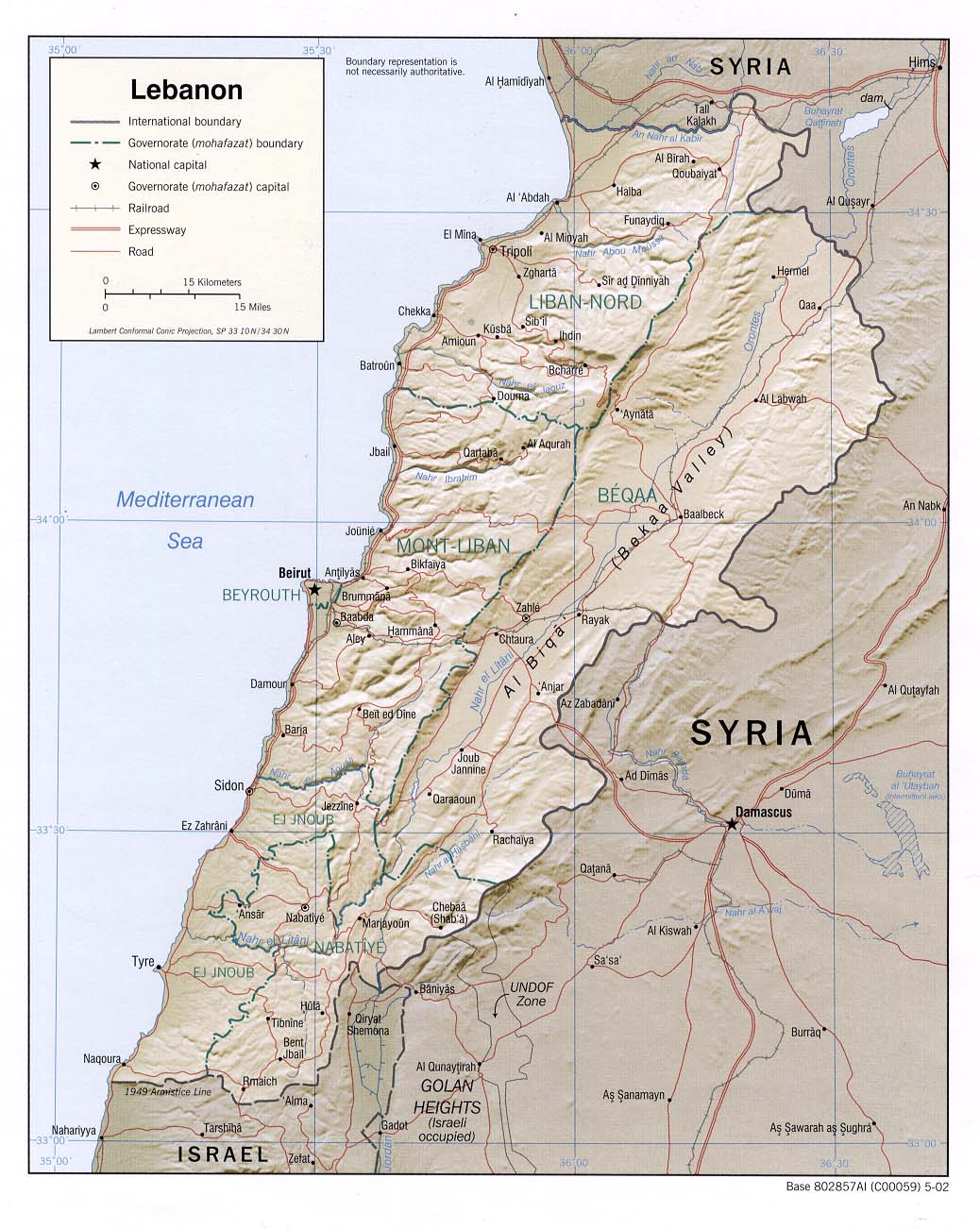
"Hezbollah's victory," October 23, 2006.

Click to enlarge
Lebanon may have slipped off the news radar, but it hasn't disappeared altogether. Offstage inquiries into the 34-day war in July and August are beginning to bear fruit.

Last week, Alistair Crooke and Mark Perry, co-founders of the Conflicts Forum, a privately funded non-profit organization in the United Kingdom, finished a 3-part series for Asia Times Online on three separate aspects of the war--intelligence, the ground war and the political consequences.

Crooke and Perry report that Hezbollah officials would "neither speak publicly nor for the record on how they fought the conflict. They would not detail their deployments and would not discuss their future strategy."

Therefore, Crooke and Perry's conclusions are derived from on-the-ground assessments conducted during the course of the war, from interviews with Israeli, American and European military experts, from emerging understandings of the conflict in discussions with military strategists, and from a network of senior officials in the Middle East who were intensively interested in the war's outcome and with whom they spoke.

Their main conclusion contradicts the view that Israel's offensive in Lebanon significantly damaged Hezbollah's ability to wage war, that Israel successfully degraded Hezbollah's military ability to prevail in a future conflict, and that the Israel Defense Forces (IDF), once deployed in large numbers in southern Lebanon, were able to prevail over their foes and dictate a settlement favorable to the Israeli political establishment.

It's hard to believe the opposite, i.e., that Hezbollah was able to dictate a settlement favorable to its own interests. Yet their study which ends saying that the war "has caused a political earthquake in the region" is plausible with only a few exceptions.

Crooke and Perry argue that "Olmert and the security cabinet violated the first principle of war - they showed contempt for their enemy." Some new details about the abduction of July 12, about preparations for war, the treatment of Lebanese collaboratorating with the Israelis, the failure of Israel's air campaign.


The attempt to take out Hezbollah's leadership in Beirut also failed. "At no point during the war was any major Hezbollah political figure killed."

The IAF began targeting schools, community centers and mosques because they believed that their inability to identify and interdict Hezbollah bunkers meant that Hezbollah's had hidden their major assets inside civilian centers.

But Hezbollah had built a network of over 600 bunkers south of the Litani River. Some were built as decoys under the eyes of Israeli drones or Lebanese citizens with close ties to the Israelis. Others were dug as much as 40 meters deep into the rocky hills. A few were even air conditioned.

Furthermore, Hezbollah had been able to maintain its attacks without any hope of resupply. By the end of the month it had used less than a quarter of its rockets.

Especially surprising in Crooke and Perry's view was Hezbollah's ability to cease fire after the Qana massacre. This meant that Israel's goal of separating Hezbollah fighters from their command structure, considered a necessity by modern armies in waging a war on a sophisticated technological battlefield, had failed.

Even more surprising, "One month prior to the abduction of the IDF border patrol and the subsequent Israeli attack, Lebanese intelligence officials had broken up an Israeli spy ring operating inside the country. "

"From the onset of the conflict to its last operations, Hezbollah commanders successfully penetrated Israel's strategic and tactical decision-making cycle across a spectrum of intelligence, military and political operations, with the result that Hezbollah scored a decisive and complete victory in its war with Israel."
Crooke and Perry do not embroil themselves in the attempt to fix blame. Although they present new information about conditions before the beginning of the war, they do not attempt to adjudicate differing opinions about who started it. That is not an issue to be decided either by the press or by a political body like the Security Council, but rather by a court with the authority to summon witnesses and to examine evidence in detail. Unfortunately, no such court is likely to address that or other related issues.

After two weeks the Israeli claim that it would "destroy Hezbollah" had evaporated.
"Gone too was a claim that only NATO would be acceptable as a peacekeeping unit on the border. On July 25, Israel reported that Abu Jaafar, a commander of Hezbollah's 'central sector' on the Lebanese border, was killed 'in an exchange of fire' with Israeli troops near the border village of Maroun al-Ras - which had not yet been taken. The report was not true. Abu Jaafar made public comments after the end of the war.

"Later on July 25, during US Secretary of State Condoleezza Rice's visit to Jerusalem, the Israeli military fought its way into Bint Jbeil, calling it 'Hezbollah's terror capital'. The fight for Bint Jbeil went on for nine days. But it remained in Hezbollah hands until the end of the conflict."

Crooke and Perry do not name any of their sources, but they identify one as "a Middle East expert with access to senior Pentagon officials." That individual is quoted as saying
"There is a common misperception that the [US] Air Force was thrilled by the Israeli war against Lebanon.... They were aghast. They well know the limits of their own power and they know how it can be abused.

"It seemed to them [USAF officers] that Israel threw away the book in Lebanon. This wasn't surgical, it wasn't precise, and it certainly wasn't smart. You can't just coat a country in iron and hope to win."


"When Israel finally agreed to a ceasefire and began its withdrawal from the border area, it left behind upwards of 40 armored vehicles." That's more than one a day. Nearly all of them had been destroyed by expertly deployed AT-3 'Sagger' anti-tank missiles.

Crooke and Perry challenge the Israeli claims that it killed 400-500 Hezbollah fighters. They base what they feel is "a more precise accounting" on the number of funerals. "It is impossible," they say, "for Shi'ites (and Hezbollah) not to allow an honorable burial for its martyrs... our most recent information from Lebanon says the number of Shi'ite martyr funerals in the south can now be precisely tabulated at 184."

Although the Conflict Forums report discusses cluster bombs and the number of Katyushka rockets fired into civilian areas in some detail, once again it does not attempt to adjudicate the issue of war crimes.

Nor does it address the political issues of most interest to Canadians such as the death of 11 members of the Al Akhras family on July 16 or the presumed accidental bombing of a UN observation post on July 25 or statements from marginal powers such as Canadian Prime Minister Harper's famous remark that Israel's response to the "kidnapping" was "measured."

But it does list ten critical effects of the war.

First, the war between Hezbollah and Israel showed that "any modern and technologically sophisticated Western military force can be defeated in open battle...."

Second, it showed
"the people of the Muslim world that the strategy employed by Western-allied Arab and Muslim governments - a policy of appeasing US interests in the hopes of gaining substantive political rewards (a recognition of Palestinian rights, fair pricing for Middle Eastern resources, non-interference in the region's political structures, and free, fair and open elections) - cannot and will not work."

As an editorial aside I will interject that Canada could learn something from this, but Harper is not the man.

Third, it had "a shattering impact on America's allies in the region....
"Mubarak and the two Abdullahs [the Kings of Saudi Arabia and Jordan] are very unlikely to support any US program calling for economic, political or military pressures on Iran. A future war - perhaps a US military campaign against Iran's nuclear sites - might not unseat the government in Tehran, but it could well unseat the governments of Egypt, Jordan and perhaps Saudi Arabia."

Fourth, it has "dangerously weakened the Israeli government."

It appears to have marked the rise to power of Avigdor Liberman, but that is a story for another day.

Fifth, in the opinion of Crooke and Perry, "the Hezbollah victory spells the end of any hope of a resolution of the Israeli-Palestinian conflict, at least in the short and medium terms....
"Abbas is in a far more tenuous position than Mubarak or the two Abdullahs - his people's support for Hamas continues, as does his slavish agreement with George W Bush, who told him on the sidelines of the United Nations Security Council meeting that he was to end all attempts to form a unity government with his fellow citizens."

Sixth, it has had quote "the very unfortunate consequence of blinding Israel's political leadership to the realities of their geostrategic position....

Crooke and Perry's colleague Jeff Aronson noted that "if it were up to the US, Israel would still be fighting", and he added: "The United States will fight the war on terrorism to the last drop of Israeli blood."
"Seventh, Hezbollah's position in Lebanon has been immeasurably strengthened, as has the position of its most important ally. At the height of the conflict, Lebanese Christians took Hezbollah refugees into their homes. The Christian leader Michel Aoun openly supported Hezbollah's fight. One Hezbollah leader said: 'We will never forget what that man did for us, not for an entire generation.' Aoun's position is celebrated among the Shi'ites, and his own political position has been enhanced."

"Eighth, Iran's position in Iraq has been significantly enhanced. ...

"Ninth, Syria's position has been strengthened and the US-French program for Lebanon has failed."

Israel has rejected an offer from Syria to engage in peace talks.


"Tenth, and perhaps most important, it now is clear that a US attack on Iranian nuclear installations would be met with little support in the Muslim world. ... We would now dare say the obvious - if and when such an attack comes, the United States will be defeated."


Of course Crooke and Perry may be wrong. But if the war between Israel and Hezbollah was a victory for Israel, no one has been inspired by it, not even the Israelis.

Digg This


Recommend this Post


More =>

Sphere: Related Content

Monday, October 09, 2006

FEATURE
Georgia on your mind? October 9, 2006.


Has Georgia been on your mind lately? Maybe not. It hasn't exactly been an obsession on The National even though the threat of war between Georgia and Russia, its large neighbour to the north, has passed. We could all give thanks and breathe a sigh of relief--if only we had known to be holding our breath at all.

It began a week before last Wednesday when Georgian authorities jailed four senior Russian military officers and 12 Georgians, accusing them of plotting a coup on behalf of Russia. Georgian Interior Ministry forces surrounded Russian military headquarters in Tbilisi demanding the handover of another two Russians.

Moscow responded by recalling its ambassador, evacuating 84 diplomats and their families and calling for an emergency meeting of the UN Security Council. By Sunday, General Andrei Popov, commander of Russian military forces in Georgia had put his troops on high alert and ordered that they shoot to kill in defence of their bases.

The Russian political establishment, including MPs, government ministers, leaders of major political parties, and Kremlin-connected political analysts, discussed the possibility of war between the two former Soviet Republics. Although it was barely mentioned here, the story was page one news in Moscow.

Georgia's UN envoy Irakli Alasania told a news conference, "It is crystal clear that the Russian peacekeeping force is not an impartial, nor international contingency."

The province of Abkhazia won effective independence from Georgia in a 1992-1993 war. Moscow pays pensions in the province, issuies Russian passports and stations peacekeepers there.

Georgia accuses Russia of backing Abkhaz separatists, which Moscow denies. A UN peacekeeping mission in Abkhazia, was established, redefined, extended and supplemented by UNSC 858, 881, 973, 1077 and 1494. Part of its mandate is to maintain contact with and observe the operation of the CIS peacekeeping force in relation to a Ceasefire and Separation of Forces Agreement between Georgian and separatist Abkhazian authorities.

Ambassador Alasania said the peace process between Georgia and its breakaway regions of South Ossetia and Abkhazia needed to be overhauled but did not explain why arresting most of the political opposition was the best way to do this.

Outside a joint meeting with NATO defense ministers, Russian Defence Minister Sergei Ivanov told a news briefing in Slovenia on Friday quote

"We should not forget that 90% of the population of Abkhazia and South Ossetia are Russian citizens. They were never citizens of Georgia. After the collapse of the Soviet Union, the local population in the region, which was then holding Soviet passports individually, sought formal Russian citizenship. And we issued passports [Ivanov said] and granted citizenship rights not only to the citizens of the former Georgian Soviet Socialist Republic but also to the residents in all other former Soviet republics.

"Millions of people opted for Russian citizenship. That was their right and prerogative." endquote

Georgian "Interior Minister Vano Merabishvili said the Russian military intelligence officers ...[and] the dozen Georgian citizens who were detained, quote 'showed a particular interest in Georgia's defense capability, its programs of integration into NATO, energy security, political parties and organizations' endquote as well as information about the nation's military forces and infrastructure. Merabishvili called their intentions a quote 'serious provocation.'"

He did not mention that some of the alleged coup plotters were also leaders of Georgian opposition organizations and parties. That information came from Igor Giorgadze, head of the bloc of Georgian opposition political parties, writing in the Japan Times.

Giorgadze went on to say that his colleagues had been quote "jailed on unfair accusations" endquote and to speak of a quote "wave of political repression [that] merely reflects President Mikhail Saakashvili's desperate effort to cling to power." endquote

Giorgadze also observed that quote "the people rounded up in the latest raid against the opposition were originally imprisoned by Eduard Shevarnadze's government, which Saakashvili helped depose in Georgia's supposedly democratic 'rose revolution' in 2003." endquote

While articles in the Western press regularly mentioned the "rose revolution" and some even recalled that it had been inspired by the US, it took Justin Raimondo (Sep 29), editor of the Antiwar.com website, to note that the net effect of Bush's democracy crusade in Georgia has only replaced one oppressive autocrat with another.

During this crisis, the Anglo-American media have cast Russia as a villain of the backpages, bullying its smaller neighbour. The Wall Street Journal characterized Russian foreign policy under Putin as "paranoid and bullying." The Boston Globe referred to Putin's "temper tantrum" and his "meltdown." The BBC found medieval torture imagery appropriate, saying that "Russia turns the screws on Georgians" endquote. Obligatory quotations from Russian officials were used to re-inforce the point, but there was no trace or hint in the Anglosphere that there might be a Russian version of events.

MK Bhadrakumar, a former career diplomat in the Indian Foreign Service for more than 29 years, writing this time for Asia Times filled in that gaping emptiness.

Russian commentators uniformly believed that Saakashvili acted with Washington's prior knowledge and approval. They saw a pattern in the sequence of events during the past three months following Saakashvili's visit to Washington.

During this period, Georgia deployed its troops in the Kodori Gorge in Abkhazia, apparently taking one step further toward seeking a "military solution" to the political separatism in the breakaway province; Saakashvili ordered a crackdown on opposition political figures who were mounting an increasingly effective campaign against the power structure in Tbilisi, allegedly for their "pro-Russia" stance; Tbilisi commenced a process of "intensive dialogue" between Georgia and NATO (which is a stipulated prerequisite as per the NATO charter for new members' accession); and last but not least, Saakashvili precipitated with great deliberation a totally unnecessary crisis by detaining the Russian military officers.

Thus, Russian commentators saw last week's developments as falling within the overall context of Russian-American rivalry for influence on the territories of the former Soviet republics. They visualized that the US geopolitical objective was to force Russia out of the Caucasus as part of Washington's agenda of effecting the Atlantic integration of Azerbaijan, Georgia and Armenia, and, specifically, of replacing all traces of Russian military presence in any corner of the region through which the strategic Baku-Tbilisi-Ceyhan oil pipeline and a future trans-Caspian pipeline run.
endquote

Bhadrakumar believes that Moscow is also attempting to foil the Anglo-American gameplan on NATO expansion by emphasizing the precedent-setting nature of the referendum in Kosovo (and Montenegro) recently held with EU endorsement and US support on the province's separation from Serbia. (Similar also to East Timor.) Moscow has argued that what the West considers acceptable in Kosovo (or Montenegro), namely, the right of self-determination, should be equally acceptable to Abkhazia or South Ossetia.

In the end, the tensions were so grave that international mediators intervened and the current chairman of the Organization for Security and Cooperation in Europe, Foreign Minister Karel De Gucht of Belgium, flew to Georgia's capital on Monday to preside over the release of the Russian officers. But not before Russia announced on Monday (Oct 2) that it would suspend air, rail, sea and automobile transportation as well as postal service between the two countries.

Saakashvili said “We cannot be treated as a second-rate backyard of some kind of emerging empire.”

Georgian opposition leader Giorgadze sums up:
The latest events clearly indicate that a czarist mentality survived the revolution, reflected in a Byzantine model of political power -- an emperor and his court -- that has as its main vehicle largely unconstrained presidential authority.

[Note: The same criticism is made of Bush. Projecting power means projecting the weaknesses that go with it. -jlt]

Before the security forces targeted the opposition bloc that I represent, supporters of educational reforms were prosecuted, while most of the press came under the influence of the government.

Saakashvili claims that the opposition forces that I represent oppose Western values. But we advocate parliamentarism -- genuine separation of executive and legislative power -- in Georgia. And, in supporting the Western model of parliamentarism, we are on the side of Georgia, not Russia. It is strange that Saakashvili, a graduate of Columbia Law School, fails to see the disparity between his own democratic rhetoric and autocratic actions.

[...]

The unfortunate paradox in Georgia [Giorgadze continues] -- and elsewhere in the post-Soviet world -- is that self-serving pro-Western rhetoric has often led democratic values to be sacrificed in favor of a new dictatorship. When the West actively supports popular revolutions, as in Georgia and Ukraine, the newly established power relies on democratic slogans, not democratic behavior.


Digg This

Map courtesy of www.theodora.com/maps used with permission.Recommend this Post


More =>

Sphere: Related Content

