Masthead graphic based on a painting by Gudrun Thriemer.

Showing posts with label Canadian politics. Show all posts

Saturday, May 16, 2009

Michael Geist, "House of Commons Lawyers sent takedown notices over committee video," May 11, 2009.

[Canadians really should know more (something, anything) about how Parliament's Standing Committees work and what they are doing. -jlt]

In the spring of 2007, Friends of Canadian Broadcasting, the well-known broadcasting advocacy group, began to post videos and podcasts of Parliamentary committee proceedings on their website. When officials at the House of Commons caught wind of their activities, they promptly sent a cease and desist letter, demanding that the videos and podcasts be removed from the Internet. A lawyer for the House of Commons argued that posting excerpts from committee proceedings could be treated as "contempt of Parliament." The group responded that they did not want to remove the videos, but would be willing to follow a reasonable procedure to obtain the necessary permissions. That response did not sit well with the Chairs of the Finance and Canadian Heritage Standing Committees, who upon learning that the group was offering webcasts and downloads of their proceedings, asked the Standing Committee on Procedure and House Affairs (SCPHA) to examine the issue to prevent further infringement.

My weekly technology column (Toronto Star version, homepage version) notes that the idea that videos of committee hearings constitute proprietary content that when used without permission raise the potential for allegations of contempt of Parliament or copyright infringement will undoubtedly come as news to many Canadians. Using these excerpts in YouTube videos, webcasts, or podcasts has emerged as an important and powerful tool for business and consumer groups to educate the public on policy issues and legislative proposals. Yet House of Commons lawyers maintain that many of these activities violate the law and have sent notice and takedown demands to YouTube seeking the removal of videos that include House of Commons and committee proceedings. These include clips that involve satire and parody, since they are seen to "distort" the video itself.

  Commercial uses still require prior approval, "distorting" a video for parody, satire or political comment purposes may still fall outside the licence and lead to demands for its removal.

Read the rest here =>Recommend this Post


More =>

Sphere: Related Content

"Canadian Conservative Party May Constituency Week Caucus Pack, May 2009," Wikileaks, May 13, 2009.

[Wikileaks is a site worth knowing. This time, they help explain how The One Man Band simulates a unison choir part. -jlt]

Summary

Canadian Conservative Party May stump speech and talking points for backbenchers. The document contains a number of current issues of interest to Canadians.

Our source states: "Just when you thought you elected a real politician, the central office of Stephen Harper comes in to tell your representative what to do. Just like was done when the Harper crew went after Mulroney, no questions are allowed."

  Thank you for that warm greeting. I always enjoy being back in [Community].

Read the rest of the script here =>Recommend this Post


More =>

Sphere: Related Content

Wednesday, April 08, 2009

Chantal Hébert , "Environment file slips from radar," Toronto Star, April 8, 2009.

[The environment portfolio isn't the first opposition fumble. Hébert reminds us of the issue of 2-tier health care. Afghanistan is another. We like to tell ourselves that the bad old boys are simply too rich, powerful and numerous for any other viewpoint to prevail. Analytical conversations on this theme here in Nelson have suggested that this may be a generational issue? Maybe it's just an existential part of the human condition. It was suggested in the previous post that Canadians are too polite. Maybe we've been brainwashed to believe that taking an action that would strike fear (of humiliation or of losing an election or both) is immoral. -jlt]

Once the hot seat of the Conservative cabinet, the environment portfolio is well on the way to becoming a question period La-Z-Boy.

In sharp contrast with his two immediate predecessors who were regular targets of opposition attacks, Jim Prentice is lucky if he gets to stretch his legs once over the course of the opposition's daily 45-minute grilling of the government.

Indeed, more often than not these days, Prentice has to rely on the kindness of his own colleagues for a chance to speak up during question period.

Forty days into the session, backbench Conservatives have put more questions to the environment minister than the Liberals and the NDP combined.

  Culture is the emerging hot-button question period issue.

Read the rest here =>
Recommend this Post


More =>

Sphere: Related Content

Tuesday, February 03, 2009

"Left" is no longer a unifying concept

This period of fragmentation on what used to be called the "left" requires calls on us to engage in analysis (includes issues of naming and framing), negotiation, and organization (includes strategy and execution). It's not exactly that the "left" doesn't exist any more, but it is no longer a unifying concept.

What the left really can't stand is that intellectual vigor has shifted to the right. You can disagree with Fraser Institute ideologues, but you can't call them lazy or stupid. They have recently produced a re-examination of Indian policy that just may be more rigorous--not agreeable or even palatable, just rigorous--than anything produced by the Government of Canada or any major political party downwind of the Kelowna Accords. You can call Michael Ignatieff right-wing with some justice, but he does his homework and asks the tough questions.

  The coalition episode revealed just how ignorant Canadians are of their bizarre democracy. Yet not one party of five showed any inclination to leap on the loose ball.

On the center-left, the NDP can't make up its collective mind whether to resume their traditional embrace of a 19th century ideology or join the bad guys who keep kicking their asses. The result? In May 2007, the NDP voted against a Liberal motion to bring the troops home from Afghanistan not later than 2009. The Bloc voted for it. The NDP voted with the Conservatives and "justified" this strange and unprincipled behavior by saying they wanted the troops out NOW! (i.e., before 2009). Not that they had a plan.

It's 2009, and they continue to suck and blow. They frittered away their only opportunity to bring the troops home before 2011. With Liberal help, the Conservatives have effectively removed Afghanistan from the political agenda. It is already clear that Canadian Provincial Reconstruction Teams will be in Afghanistan till 2015; bringing the troops home will likely have to wait till after that. But the point is that NDP "strategy" appears to have been crafted by a precocious high school students council vice-president or maybe her budgie.

Note also that NDP Middle East policy has collapsed since Sven Robinson turned himself in. Layton is a good municipal politician with a principled and well-developed position on homelessness and other municipal issues. In foreign policy, however, he got blown off his bicycle years ago, and the party has no answer for this deficiency.

Finally, consider the coalition. The NDP was being urged to form a coalition before the election. They demurred. When they came back, they voted along with practically everyone else for the Fall Throne Speech. Then--and only then--did they decide to form a coalition. Bad timing. The missed opportunity that is as good as a mile. By the time the coalition hit its peak, the Government still had near unanimous de facto support (NDP, Bloc, Libs). The Governor General had practically no choice but to prorogue Parliament at Harper's request. Good game plan this time, rotten execution. Poor attention to detail. C- and yes, this will be on the final exam. Witness a "left" that has earned its fragmentation.

Socially and economically the Greens are all over the map. After almost 30 years in Canada and with persistent and un-deserved attention from the national media, the Greens have barely been able to elect someone to a school board. A strategic re-think is overdue. They aren't hungry; they aren't desperate; they aren't out pounding the pavement, knocking on doors and discovering the "social libertarian" vote, debating with anarchists, and figuring out how to serve a real consituency or two.

Instead, the Greens have persisted in the strategy of running a candidate in every riding, even though it is almost certainly not a prudent use of their limited funds and has not delivered results. The half-baked campaign here to promote STV as the only democratic reform they favour isn't likely to get off the ground either. We don't need larger ridings; in the Interior, we need smaller ones, but the Greens aren't listening.

Furthermore, the lesson of stolen elections in the US should alert Canadians to the perils of a complex and invisible method of counting votes. For those of a more traditional left persuasion, there is a famous quote from Stalin that makes the same point.

For what it's worth, the process was handcuffed from the beginning. The BC Greens along with the rest of us accepted the premise that there will be no more representation, just a shuffling of how the representation is elected. BC has a huge rural-urban divide that leaves the Greens particularly vulnerable unless they can bootstrap the vigor for a comprehensive re-examination of fundamental questions. The coalition episode revealed just how ignorant most Canadians are of their bizarre democracy. Yet not one party of five showed any inclination to leap on the loose ball.

The Greens may be too grateful for the money that the parliamentary subsidy provides them. It saves them the inconvenience of having to go door-to-door with a coffee can. But there can be no doubt that the parliamentary subsidy for political parties serves the status quo. It didn't deliver in the 2008 election. Combined with STV, success of this grand strategy might result in one seat in parliament, probably at the expense of the NDP.

That's not good enough. Any analysis that ignores the 30-35% of registered Canadian voters who decide not to vote isn't good enough. That seems like a good starting place. To that, I would add that a federal strategy which refuses to work with separatists is unlikely to get beyond the regionalism that characterizes the current configuration.
Recommend this Post


More =>

Sphere: Related Content

Sunday, February 01, 2009

Robin Mathews, "Three Strikes Against Michael Ignatieff," Vive le Canada, January 30, 2009.

[In due course, Canadians will have to outgrow the model of democracy that views elections as a multiple-choice exam that has only four mutually exclusive answers. The coalition of the future will include independents and members of all parties--though not all the members of all parties. This will likely entail some re-education that rejects the one-dimensional model of political description. -jlt]

A truth lodged in the minds of many Canadians is that “You can’t trust Stephen Harper”. What can those Canadians do now when they have to add “You can’t trust Michael Ignatieff, either?”

Ignatieff’s demonstration that he prefers the politics of Stephen Harper to those of Jack Layton is Strike Three. That is so, especially, in the light of the NDP’s obvious willingness to go a long way towards the Liberals in order to make a coalition work.

  ...an apology and retraction from Ignatieff some time in the future will be of little use or comfort.

The basic fact has to be acknowledged. Ignatieff feels closer to the Stephen Harper group than to the New Democrats – and Stephen Harper is a Far Right Reactionary. Ignatieff has, in fact, entered a coalition of the Far Right. As Liberals across Canada awaken to that fact they will suffer some sleepless nights and some powerful testings of their loyalty to the Liberal Party.

To begin: already the Far Right nature of the budget is being uncovered. There is no genuine effort to deal with the immediately unemployed. Nothing has been built in to shore up and grow scientific, medical, and research capacity and (Canadian) independence. Over-kill on (permanent) tax breaks for large corporations is high-profile. More will follow. That’s fine with Michael Ignatieff who has always been on the Right of the Liberal Party.


Read the rest here =>
Recommend this Post


More =>

Sphere: Related Content

Wednesday, January 28, 2009

End Times for the Liberal Party?

What if the Liberal Party is on its last legs?

In a 2000 special chapter for *The Other Davos* ("Beyond Neoliberalism," Christava Sahitya Samithi, Thiruvalla, Kerela, India, November 2000), British socialist and founder of The New Left Review, Perry Anderson lists three lessons to be learned from neoliberalism:

1) "Do not be afraid of opposing the dominating political current in a certain period."

2) "Do not make compromises concerning ideas."

3) "Do not accept as immutable any established institution." (cached on the internet).

  The Liberal-Conservative coalition can be broken by eliminating the federal subsidy for poltical parties, but it will take courage.

This is not the place to deconstruct Anderson's argument in detail, but each of these points deserves attention. For my money, the first lesson is pure inspiration. "Do not be afraid of opposing the dominating political current in a certain period." This means that we learn from the neoliberals, if not from elsewhere, that in addition to resistance, a long-term commitment is required. Without one, the long-term is (manifestly) getting shorter and shorter. If the next election is held in the summer time, will there be any arctic ice? What big employer will go bankrupt and/or need a bailout next week?

Ignatieff is said to be rebuilding the Liberal Party. In fact, he is rebuilding the aristocratic tradition of noblesse oblige rebranded as liberalism.

Use of the word liberal and its derivatives is especially frustrating. It is not clear to everyone why liberalism is now seen as a right-wing philosophy, why neoconservatives are neoliberals--and so are liberals--or why neoliberalism has found its most earnest expression among governments commonly characterized as extreme right-wing governments. We thought liberals were left.

Canadians try to salvage this debased terminology by talking about "small el liberals" and "capital L Liberals." A more fruitful approach entails recognizing that the description of political positions as "left" or "right" is both anachronistic and one-dimensional. Anachronistic because it is rooted in the parliamentary seating arrangements during the French Revolution. Those who sat on the right supported the monarchy and aristocratic privilege, especially in land tenure. Those sitting on the left opposed the monarchy and supported reform, power to the workers.

Organizers of the First International (Wobblies, IWA, 1864) saw themselves as the revolutionary successors of the French parliament's left wing. The terms "left," "leftist," and "left-wing" are most closely associated with socialism, communism, anarchism, and to a lesser extent social democracy and social liberalism.

In the United States and Canada liberalism is seen as "left." Government intervention is regularly described as "socialism."

But *Liberalism* (aka The Free and Prosperous Commonwealth) is also the title of a book by now influential economic thinker Ludwig von Mises who bases his liberal ideology on property rights. Once the exclusive domain of monarchs and the aristocracy (i.e., the right wing), property as a privatized real estate commodity becomes, in von Mises' hands, the foundation for liberal freedoms, peace, social harmony and the general welfare. This is related loosely to the notion that capitalism = democracy.

Unlike the New Deal liberals of the US, von Mises and neoliberal followers of the Austrian school oppose government intervention in the economy. The concept of economic liberalism (also via liberate to economic freedom) was also formulated by Adam Smith and finds most ardent support today at Vancouver's conservative Fraser Institute, though we also encounter earnest market anarchists--who are not left-wing. (So there is left-wing anarchy and right-wing anarchy.) Economic liberalism is described as both conservative or right-wing although it is neither monarchic nor aristocratic.

We could go on, trying to salvage what is a way of speaking practically devoid of meaning, useful only for purposes of propaganda and emotional manipulation. If corporations are the new aristocracy, monopoly could be seen as an economic version of monarchy, etc. This may temporarily redeem the terminology, but it won't change the reality that this particular body of political language is on life support.

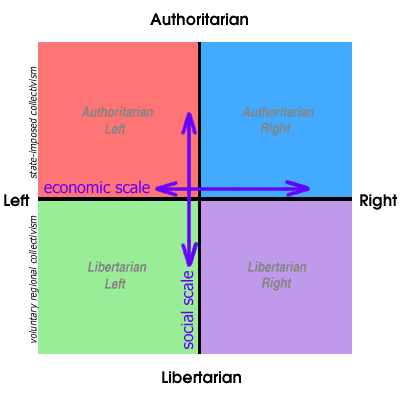
In addition to being anachronistic, the left-right axis is, as Political Compass website demonstrates, a one-dimensional concept that systematically oversimplifies what we really need to talk about with greater, not less, precision and accuracy.


Political Compass offers an interesting interim solution because it opens the door to a second dimension of political discussion. What if other dimensions were to be explored as well? There a many implications to the addition of even this second dimension.


As Orwell pointed out, caution about political language, especially euphemism, is always justified. In a post-budget article (NDN Jan 27 09), Stockwell Day describes the condition of the US economy in the most unctious terms: "when buyers in your biggest market start to ease off of their buying because of a slow down...", he says. But buyers in the US aren't "easing off" because of a "slow down." The folks that reckoned they had a rich tycoon on the hook who wanted to send them money just found out that the rich tycoon, while not broke, is out of business and may have left the country. People like us aren't "easing off;" we are hunkering down. Poverty can be paralyzing. We are deciding not to buy, not to borrow, not to trust the wheelers and dealers at all--not again, not in the least. Opposition to the political current may be about to bear fruit.

I view Anderson's second lesson with a weary eye. He presents "Do not make compromises concerning ideas" as a strength. But that doesn't mean we should imitate all of what brought neoliberalism to power. Anderson admits that the neoliberals' ideas were extreme and lacking in moderation. "They were iconoclasts for good thinkers of that time." Certainly, after eight years of George Bush, we may need to remind ourselves not to "mis-underestimate" neliberalism. Anderson begins by recalling "its energy and its theoretical intransigence, its dynamism....It is a formidable adversary that has obtained many victories in the course of the last years, even if it is not invincible."

Certainly, the refusal to compromise made Friedman, Greenspan, Clinton, Bush--and Harper--tough opponents. But it is also the basis for much of the damage they caused. The tragic failure in Iraq is coming to an end only to the degree that the Americans are finally ready to leave. That is the ace of trump in any occupier's hand. Military intransigence in Afghanistan has had the effect of giving the Taliban an enemy to defend their homes against--just about the only thing they do well.

It's not an uncommon lesson. The embrace of uncompromising military power produced Israel's failed rampage against Hezbollah in 2006 and elevated Iran as a regional power. Then, as if to demonstrate that he had learned only the trivial and insignificant lessons of that humiliation, Olmert refused the compromise of extending a ceasefire and overestimated the value of raw military might with yet another tantrum--this time against Hamas. Intransigent belligerence may occasionally lead to pyrrhic victories, wish-fulfilling illusions of victory. But in the end, it is the bough that bends that does not break.

For everyday Canadians, Ignatieff's acceptance of the Conservative budget means salvaging unregulated corporate globalism by reestablishing the Liberal party as a gofer-in-chief for Canada's big corporations, that is the ones that haven't already gone bankrupt. Full dependence on the failing American economy is fine and dandy.

But the real crisis in the Liberal party isn't just leadership; it's money--and more. The Liberals have constructed themselves as the main magnet for big corporate donations which (mercifully) aren't legal any more. A further problem is that increasingly, the surviving big corporations aren't Canadian--or in business--any more either. It is one thing for a corporation to be governed by its shareholders. It is another entirely for the whole of any country to be governed by them as well. Ignatieff has chosen quicksand.

The coalition of everybody else need not be a coalition of political parties or blocs. It will be good enough for our long-term plan to build a coalition one vote and one voter at a time. Who among all the parties--Bloc, NDP, Green, Liberal and (new) Conservative--is ready to work for grassroots funding and a more representative democracy? Who wants to know what are the real issues? It's high time they were brought forward.

The new alliance of Liberals and Conservatives is a alliance of Toronto, Alberta, and Saskatchewan with cheering sections in Newfoundland, Labrador, the Yukon and a handful of federalistas in Quebec. http://www.cbc.ca/news/canadavotes/ It is, in other words, a alliance of new tar and the old manufacturing elite. That makes a coalition of everybody else critically responsible for the future--economy, environment, the several sovereignties, democracy, Canada-US relations, the Arctic, the poor--the works.

And that brings us to Anderson's final lesson: "Do not accept as immutable any established institution." Especially not the Liberal Party. The Greens above all should keep that in mind, both regarding the Liberals and themselves as well. If the (old) Libs go the way of Mulroney's PCs, why would all those voters be voting for someone else? We may find out. A political debate that the Liberals cannot dominate will evolve a new dynamic. That could be a welcome development to anyone willing to accept that the unpredictable may be preferable to the certainty of long-term economic and environmental decline. What hope is there in that?

The plan to eliminate the federal subsidy for political parties was really aimed at the Liberals, but it attacked the Greens too, at least in the short term. For nearly three decades now, the Greens have scarcely been able to elect someone to a school board or municipal council. The environment is in need of defence, almost as desperately as the Green Party is in need of an effective strategy. The Liberal-Conservative coalition can be broken by eliminating the federal subsidy for poltical parties, but it will take courage.
Recommend this Post


More =>

Sphere: Related Content

Monday, January 26, 2009

Coalition members sideline themselves with dumb "strategy"

In a fit of strategic juvenalia, the NDP and Bloc have telegraphed that their vote against the budget is a foregone conclusion. Nothing like tipping your hand to make the next move easy for your opponent. That means the two marginal parties will attend the budget speech tomorrow to find out what they are against. The Liberals and Conservatives are the only players who matter. It didn't have to be that way.

For the time being, polls showing in excess of 40% support for Conservative leadership or showing that 44% prefer Conservatives as managers of the economy are relevant only if an election is actually called. Otherwise they are best seen as volatile and subject to change in response to inspiring performance. Of both immediate and long term concern is creation of the conditions that would incline the Governor General to prefer a coalition government over another election in the event that the budget fails to pass. Demonstrating the ability to work in a coordinated manner at least over the short term will be an important pre-requisite.

Given a chance by the GG, a coalition government would have the opportunity to prove itself to a skeptical public. Success in that project would depend on the depth and effectiveness of the coalition's policies. That much is right now in doubt. The new Alternate Budget just released by the CCPA should help. BC Premier Campbell is already calling for "shovel ready" projects. Long-term planning as would be required for personal rapid transit, geothermal, wind, and solar energy projects, a federal/provincial pharmaceutical industry, a revived forest industry is not part of the "shovel ready" concept.

However, the ascent of Michael Ignatieff to the Liberal leadership is a step in the right direction. Although I would have preferred Bob Rae, a reluctant coalitionist may be just what the public requires to help it change its mind. And that may be a long-term project in itself. As for Ignatieff, changing his mind or giving the illusion of changing his mind (as he has with Iraq, has contemplated with torture, and seems he might do with Afghanistan) is entirely in character. A coalition led by Ignatieff might be the most stable political configuration of all the currently available possibilities.

Assuming success, which of course is the question, a substantial run by a coalition government (15-20 years, which is strictly speaking a massive fantasy) could do more than any other approach has so far, to moderate the separatist threat by demonstrating that Anglo-Canadians are capable of the required accommodations which would benefit the whole country--including sovereigntists of the aboriginal kind. At the moment, it appears that the mood of the country is to blame the sovereigntists, not to entertain the idea that we are the ones who need to change.

The Ottawa Sun this morning reports budget gossip by unnamed "federal officials" as revelation.

"In the run-up to budget day, federal officials have revealed some of the big-ticket deficit spending: $1.5 billion for job skills retraining, $2 billion for social housing and tax cuts for the middle class."

But the Bloc and the NDP don't have to think about it. Not a very encouraging sign.Recommend this Post


More =>

Sphere: Related Content

Saturday, January 24, 2009

Chantal Hébert, "All the pot stirring benefits Liberals most," Toronto Star, January

[In this piece, Chantal Hébert seems to be juggling mixed messages. But there is information here I haven't found elsewhere in the Anglo press. -jlt]

Montreal - Arguing that replacing Stephen Harper with a more progressive prime minister was an absolute priority, the NDP and the Bloc Québécois set aside some signature policies to strike a coalition pact with the Liberals last month.

  Polls show that Ignatieff's accession to the leadership raised public acceptance of the coalition.


Jack Layton agreed to stand down on his call to end the Canadian mission in Kandahar and Gilles Duceppe agreed to take no for an answer on a host of Bloc-specific agenda items, including allowing Quebec's language law to take precedence over the federal Official Languages Act.

The arrival of Michael Ignatieff as leader did not dampen their public enthusiasm for a Liberal-led coalition government. In the week leading up to the budget, Layton and Duceppe have continued to talk up that prospect.

Their thinking presumably is that if, as is widely expected, Ignatieff defaults on the coalition next week, they will go after him with all guns blazing. But they might end up shooting blanks.

Read the rest here =>
Recommend this Post


More =>

Sphere: Related Content

Wednesday, January 21, 2009

Budget, budget down the hall, are there any suckers left?

To mix up some metaphors, the milk has already spilled from the golden bailing buckets. Last November, Harper's minority government infuriated even its own support by issuing a fairy-tale bubble update that predicted the country would stay in surplus over the next five years as long as it did not embark on measures to stimulate the economy and that resulted in the "coalition of everyone else."

Today, the NDP and the Bloc have handed the ball to Michael Ignatieff who believes he is rebuilding the Liberal Party by implying he might support for the budget if Harper uses prettier smoke this time. Or not.

In today's Star, Chantal Hébert notes that "Harper has no control over the major pieces in the global financial puzzle," like who's going to believe his jive this time. She goes on: "If they don't fall into place [i.e., the pieces of the puzzle], his budget will have little or no durable positive impact and it will turn into an albatross around the neck of the Conservative party." Dig the mix.

She believes that "Too much of its success lies elsewhere [i.e., both the puzzle and the albatross], in particular in Washington and the presidency that was inaugurated yesterday." But that is only partly true.

Much of the budget's success or lack thereof depends on unknown synergies, lurking beyond the margins. Moving right along to some figure-skating lingo, if the UK economy is indeed in a death spiral from a nationalizing of its banks and the US is sopping up the credit pool for its massive golden buckets, not even the banks will want to go into debt, and consumers have already figured out that much. Good risk has become an oxymoron.

Really good risk has nothing to do with banks and even less with politicians. A period of cash-and-carry and real-time, real-world asset value (including barter) is just around the corner. Future me no mortgage-backed liquidity drought. Shell-game me no triple-A rated paper sorcery.

There is no magic bullet. Some dreamers are still trying to determine where the bottom is, but the smart money has started to swim. Any direction will do. There is no shore in sight.
Recommend this Post


More =>

Sphere: Related Content

Monday, January 19, 2009

Chantal Hébert, "Days of cutting Charest slack are over," Toronto Star, January 19, 2009.

On his way out of Friday's first ministers meeting, Premier Jean Charest hammered a few more nails in the coffin of Conservative hopes in Quebec. He may have banged his own fingers in the process.

  Some are asking what point there is in having a federalist in power in Quebec if he is going to conduct his federal-provincial relations like a sovereignist.

With some of his provincial colleagues looking on, the premier stood at the microphone and described Stephen Harper as an untrustworthy partner who has broken his word on equalization and the promise of a more open federalism.

For Quebecers, the sight of a federalist premier lambasting a prime minister with sovereignist abandon was something of a novelty. And while Harper stayed above the fray in public, the Prime Minister's spin doctors fully reciprocated with acrimony of their own in private.

To make a long story short, the level of animosity between the two governments has reached a new high.

Read the rest here =>
Recommend this Post


More =>

Sphere: Related Content

Friday, January 16, 2009

Tom Barrett, "Oilsands 'change everything' says Ignatieff," The Tyee, January 15, 2009.

[Sounds like love at first sight. Tar or oil? No matter. Just a glimpse makes him think he can fly. Mr. Nuance loses it, gets swept up in the gee whiz of it all. -jlt]

The Alberta oilsands will allow Canada to stand up to the U.S. on everything from Arctic sovereignty to rewriting NAFTA, Liberal leader Michael Ignatieff said Wednesday.

Ignatieff told a town hall meeting in a Gastown pub that Canadians are just starting to understand “how powerful the oilsands make us.”

Read it all here =>
Recommend this Post


More =>

Sphere: Related Content

Monday, January 12, 2009

Chantal Hébert, "Liberals ponder merits of a shift left," Toronto Star, January 12, 2009.

The most fundamental question Liberal Leader Michael Ignatieff will have to address as he ponders whether coalition-building with the NDP is still worth pursuing is whether the key to the future electoral success of his party lies in moving it further to the left.

[...]

For his entire tenure as leader, Dion pushed the envelope of a greater integration of the country's progressive forces. He tested an electoral coalition with the Greens and Elizabeth May. He endorsed left-leaning signature policies. He brought the Liberals under the umbrella of a progressive parliamentary coalition.

Those efforts resulted in Conservative gains at every step of the way. While Dion led his party to a historical low in the popular vote, Harper took over some key Liberal real estate in the October election. The subsequent crafting of the Liberal/NDP coalition propelled the Conservatives into majority territory in the polls for the first time since they came to power in 2006.

Read the whole article here =>
Recommend this Post


More =>

Sphere: Related Content

Wednesday, December 31, 2008

Josee Legault, "Coalition debate reveals our appalling ignorance of Parliament," Montreal Gazette, December 26, 2008.

I know this won't read like much of a holiday column. No references to It's a Wonderful Life, or anything like that. But there's something the political scientist in me needs to get off her chest about one thing that happened in this country this year.

  Canadians don't elect a prime minister and government - Parliament does

I'm referring to something that was revealed when the federal opposition parties were talking about a coalition government: the abyssal ignorance, even in parts of the media, about how our own parliamentary system works.

Read the rest here =>
Recommend this Post


More =>

Sphere: Related Content

Friday, December 26, 2008

"Almost Half of Canadians Are Open to Proportional Representation," Angus-Reid News Flash, December 2008.

Following weeks of political turmoil in Ottawa, Canadians are taking a second look at their existing electoral regulations, and almost half of them believe the implementation of a proportional representation system would be good for the country. In the online survey conducted on the Angus Reid Forum, 33 percent of you believe the current first-past-the-post system, where candidates win seats by getting more votes than any other rival in a specific constituency, is the best one for Canada. However, 47 per cent of members would be open to trying different guidelines.

Respondents who voted for the Conservative Party in the last federal election are the
staunchest defenders of the first-past-the-post system (47%), while more than 60 per cent of those who supported the New Democratic Party (NDP) or the Green Party believe it is time to change the system.

Read the rest here =>(PDF, 5pp)
Recommend this Post


More =>

Sphere: Related Content

Monday, December 22, 2008

Getting the measure of Michael Ignatieff: A reply to Eric

To be fair, one tries to turn what you provide--a couple of proper nouns (Arar and Iraq) and a quotation taken out of context--into meaningful propositions. But this is mind-reading at best and isn't likely to get much past the usual cliches. That said, your position appears to be that Ignatieff must be a liar because Bush is a liar and, at the crucial time, Ignatieff supported Bush's war in Iraq. You are entitled to your opinions, but we don't learn much of strategic value either from guilt by association or from poor logic (circular reasoning, fallacy of the excluded middle). Approximately the same suspicion is more articulately stated, leading to a more specific charge, by Stephen Gowan. Details are still skimpy. If all you want is to decide who to vote for, that may be enough. If you think we may have to deal with Ignatieff as a PM (and leader of a coalition government), then more will be required.

The background of this discussion is here and here. The current facts are available here (torture) and here (Iraq). You just don't like them, Eric.

The missing facts are the one's required to support the judgement that Ignatieff is a liar. Simple nouns (Arar, Iraq) fail to substitute for reasons. The usual method is to compare spoken positions to actions on the ground, preferably over a long time. The onus is on you, Eric, though we all have an interest if you can prove that Ignatieff is actually lying. Innovation will be welcome, but sloppy work is just a pain in the ass.

I suggest again that this will lead to the question -- Is Ignatieff a pragmatist or an opportunist? Terry G thinks this is a faulty question. Not a loaded question like "Have you stopped beating your wife?" but more, I would guess, like "Did you walk to school or bring your lunch?" I think he misunderstands the question (see poll).

  We have a serious need to get the measure of the man said to have "the coalition in his pocket."

Coffee shop conversations and Canadian comedians commonly portray Ignatieff as an ivory tower academic with an unnecessarily large vocabulary. It doesn't take much research to support this position. It gives rise to the counter argument that he is not an idealist but a pragmatist.

Others (like you? and the National Post) argue that he has no integrity, is simply addicted to power and that he will say anything to get himself elected, a view that finds increasing support when it is applied to Harper, but not so much Ignatieff. This view is an extreme variant of the notion that Ignatieff is an opportunist, i.e., that he goes beyond merely capitalizing on opportunities, say to forward his possibly idealistic agenda, and is instead in the grip of a serious psychopathology.

Getting the measure of Michael Ignatieff will be no easy task. Failure to read (and listen) for context and tone will lead to serious mistakes. Is he an idealist? a psychopath? an opportunist? a pragmatist? or some combination? is there some more accurate or thought-provoking appellation?

Glavin's analytical vocabulary goes well beyond "liar" and "bullshit," but he declines to be critical. Instead he is infatuated with Ignatieff's resume and dazzled by his suits. We're going to have to get beyond that.

Glavin meets Ignatieff presumably in "a restaurant booth in a dark corner of the cavernous tropical atrium of the Rainbow Country Inn in Chilliwack" and finds him "dashing." I have only seen him on TV, and he puts me in mind of Count Dracula. Thin crooked lips, big canines. Could I watch him sink those fangs into a juicy filet and suppress the desire to make a dash for the garlic? I don't know.

But I do remember when the Turner-Mulroney campaigns got derailed by a public obsession with the leaders' chins.

All that is just so much sand in the face. We have a serious need to get the measure of the man said to have "the coalition in his pocket."
Recommend this Post


More =>

Sphere: Related Content

Saturday, December 20, 2008

Preston Manning, "Here's how we fix Canada's political mess," Globe and Mail, December 18, 2008.

The situation is now well known. Partisan overkill by the government (trying to kill the public subsidy to political parties) leads to partisan overreaction by the opposition (the creation of a coalition to bring down the government). The coalition must justify its partisan reaction on other grounds, so it claims to have formed because the government has "no plan" to address the deteriorating economy. This claim simply ignores the government's tax-relief measures, increases in health-care transfers, increased infrastructure investments, and credit and monetary initiatives.

The Governor-General wisely agrees to an adjournment of the House of Commons, which will reconvene at the end of January for the government to present its budget. If the budget, adjusted to accommodate some of the opposition's demands, is passed, the Harper government will carry on, subject to the constraints of minority status. Defeat of the budget could lead to the government's replacement by the coalition (if it still exists) or, more likely, to an election.

Don't miss the comments here => or Galloping Beaver's analysis here =>
Recommend this Post


More =>

Sphere: Related Content

Friday, December 19, 2008

Garth Turner, "Adrift," The Turner Report, December 19, 2008.

[It's worth the trouble to enlarge the graphic enough to read the quotations. -jlt]


Thanks to Toronto lawyer and chartist Ted for sending me this vibrant and visual reminder of the influence an errant, make-it-up-as-you-go leader can have on investor confidence during a time of financial volaility.

Both voters and markets have been misled, miscued, deceived and dismayed by the ramblings of pseudo-economist Stephen Harper. He called an election saying Parliament was dysfunctional, and after the election shut Parliament down. He campaigned vowing never to run a deficit, and is now on the verge of ushering in the biggest moneypit in almost 15 years. He said there’d be no recession in Canada, and just weeks later was comparing current events to 1929. He brought in an economic statement which he disavowed three days later. He won the election and scant weeks later almost lost his government over economic incompetence.

  In fact, this week new evidence confirms views expressed here over a year ago that Ottawa’s own actions in creating Canadian subprimes played a big part in digging the hole we now stare out of.

Read the rest plus comments here =>
Recommend this Post


More =>

Sphere: Related Content

Chantal Hébert, "Tories can learn from Quebec history and polls," Toronto Star, December 17, 2008.

  With the focus off unity and onto issues such as culture, climate change and the economy, the common ground between the federal Liberals and francophone Quebec is larger than the sum of their differences for the first time in decades.

The coalition cobbled together by the opposition parties earlier this month has so far achieved what no Conservative initiative had managed to accomplish since Stephen Harper came to power in 2006. A weekend poll pegged Conservative support at 45 per cent nationally, placing the party well into majority territory.

The Ipsos Reid-CanWest poll also confirmed that unrest with Harper's government is largely contained within Quebec. There, the Liberals are outpolling the Conservatives two to one (32 per cent to 16 per cent) for the first time since Harper came to power.

So which is it? Are the Conservatives finally on the cusp of an election majority, as their national numbers suggest, or are their declining Quebec prospects a harbinger of a future demise?

Read the rest here =>
Recommend this Post


More =>

Sphere: Related Content

Wednesday, December 17, 2008

"Tax havens, sovereignty and coalition government," December 15, 2008.

  But here we see the so-called separatists persistently advancing a position for the benefit of Canada as a whole.

For a lot of Canadians, the sticking point in the Liberal-NDP coalition is that it is in league with the Bloc Quebecois.

I don't know much about the BQ, but I do know one thing I can share. A couple of years ago, I was researching a story on tax havens. Canadian companies use deliberately weak tax laws like Barbados, Cyprus or Malta to avoid paying taxes in Canada.

It's a big story that is almost completely unreported--like so many others: electoral reform, genocide in Darfur, sexual violence in Eastern Congo, blood diamonds or Uganda's multi-million dollar gold trade, to name just a few.

Ralph Nader writes about tax havens. In an article for CounterPunch, he cites Lucy Komisar of the Tax Justice Network in the US. She says “The tax haven racket is the biggest scam in the world" (Jun 12 07). It's one of those inherently international problems that will never be discussed by municipal councils or even provincial legislatures.

The OECD has taken up the problem of harmful tax practices and lists 36 countries as tax havens. In 1992, the Auditor General estimated that the existence of tax havens, including but not limited to Barbados, has resulted in hundreds of millions of dollars in reduced Canadian tax revenues. More recent estimates by Statistics Canada run to tens of billions of dollars.

Nader's colleague, Lucy Komisar says that "...corporations and the rich have opted out of the tax system." and estimates that “half of world trade is between various parts of the same corporations.”

But this morning isn't a story about tax havens per se. You can find out more by reading the Nader article in CounterPunch or, for Canadian information, Hansard for the House of Commons. In 2005, Bev Oda was the Conservative Party's Canadian Heritage critic. During the 1st session of the 38th Parliament, she introduced what is the most comprehensive and detailed public information I have seen about tax havens in any jurisdiction.

The point for now is simply that this is not an inherently left- or right-wing, liberal or conservative issue. But since the Conservatives have come to form the government in 2006, they haven't said much about it.

However, one party has consistently raised the issue and introduced motions in the House to restrict or eliminate the use of tax havens. In 2001, Mr. Yvan Loubier, who was at that time the finance critic for the BQ raised this matter (Hansard Mar 2 01).

Again in 2003, Pierre Paquette (Joliette, BQ) moved: that in order to ensure tax equity, the government should terminate Canada's tax convention with Barbados, a tax haven, which enables wealthy Canadian taxpayers and companies to avoid their tax obligations, and that Canada should play a leadership role at the international level in activities to eliminate tax havens. (Hansard Sep 18 03)Again, in 2005, BQ Member of Parliament Mr. Guy Côté presented a similar motion. (Oct 6 05)

Like so many groups the mainstream media characterizes as "extremist," the defining characteristic--in this case "tearing Canada apart" or some vividly overstated version of the same idea--is really a conclusion reached after years of facing defeat, marginalization, misrepresentation, stonewalling and indifference on numerous other issues of importance.

Often there is a debate with in the "extremist" group about the value of democracy and even nonviolence as opposed to armed resistance.

But here we see the so-called separatists persistently advancing a position for the benefit of Canada as a whole. Whether the Liberal-NDP coalition with BQ support survives or not, it may be time to start choosing the less inflammatory terminology for framing the issue of Quebec sovereignty.

If we look at sovereigntist/separatist movements around the world in Chechnya, in Tibet or Xinjiang province, the Iwo in Nigeria, the Basques, or Irish republicans--to name just the best known--Canada has fared especially well in finding a political accommodation within Parliamentary democratic traditions.

In the last week or so, Stephen Harper has used the word "separatist" to stoke fear in the western provinces that the only item on the Bloc's agenda is to separate from Canada and that the Bloc would use their position in the coalition to gain concessions, especially in the form of a disproportionate amount of taxpayer's money for Quebec. But when speaking in French he uses the word "soveraintiste" or sovereigntist.

[clip how they choose to be described]

For Terry Noble at the Globe and Mail, "sovereigntist" is "politically correct" and deceptive; "separatist" is "the truth" and "the real word."

Norman Spector takes sovereigntist, separatist, secessionist and splittist to mean the same thing but with different connotations. Sovereigntist is "a positive word that emphasizes the country they hope to construct," while separatist is "a negative word that emphasizes the country they would de-construct."

"Secessionist," he seems to suggest, is neutral. But secession is the word used to describe an especially destructive American form of separation that resulted in the most lethal, fratricidal war ever to occur in the Western hemisphere.

Blogger Impudent strumpet looks at the terms from a linguistic perspective and agrees that "'separatist' is negative and 'sovereigntist,' positive.
"Separatists want to break away from something to which they belong, to destroy an existing union, The connotations are usually a bit extremist and a bit irrational (think Basque separatists, white separatists, black separatists, Tamil separatists, etc. etc.)

"'Sovereignty,' on the other hand, is a good thing. One's sovereignty over one's own body. Canada's sovereignty over its northern waters. Sovereigntists want to preserve their existing rights and freedoms.

"They are two separate concepts. They are separate concepts in most parts of the English-speaking world, and they are separate concepts in cognate languages, including French."

She attributes no motive to Harper for using the negative connotation in English and the postive in French. But Harper is clearly trying to frighten anglophones with the dual sociialist and separatist bogey men. And he is trying to woo Quebec voters.

Whenever Albertans don't get their way, threats of separation pop out of the woodwork. Fully believing that they ARE the West, Albertans have forged a theory of

"Western alienation" from this feeling. Newfie separatists come forward from time to time, regretting, as they say, that they ever allowed Joey Smallwood to convince them of Confederation. There are also separatists in BC who hunger for a chance to test their self-sufficiency.

More serious in the Canadan context are the sovereigntists--both those in Quebec and those among First Nations whose call is for territorial self-determination. Sovereignty differs from separation.

We all claim some form of sovereignty--over our bodies, our minds, our personhood. Canadians assert their sovereignty in the Arctic and worry that their sovereignty is threatened by the NAFTA, the Security and Prosperity Partnership and negotiations for a North American Union.

As Chantal Hebert suggests, this may not be the final form of the coalition.

[clip the discussion of these arrangements will become less foreign]

At least some Liberals are not ready to shut down tax havens. Martin's shipping companies made extensive use of them. Some Conservatives probably are--Bev Oda at the least. The NDP doesn't appear ever to have addressed the issue and cannot really be said to have much of a serious philosophy of taxation. But we all understand sovereignty and we understand the breakdown of democracy.

[clips the people are engaged]

Just recall, for instance, these excerpts from the APTN townhall meeting about the Duty to Consult, played several weeks ago.

[clips conducting band business from jail 2:25]

With the time that remains, let's give an ear to their discussion, with special attention to how the multi-dimensional issues of sovereignty and self-determination arise from a range of other considerations.

Jean Teillet is a Metis lawyer who explains her own credentials toward the end of her presentation. Joan Jack is Anishnabe and a lawyer. She worked on negotiations at Taku Lake.

[clip duty to consult part 2, 17 min]

Audio
A podcast of this piece--with the clips--is available here.

Audio sources of the quoted clips are available from the

At Issue Panel, December 3
At Issue Panel, December 5
APTN townhall on Duty to Consult, October 1


Recommend this Post


More =>

Sphere: Related Content

Sunday, December 14, 2008

Ignatieff, climate change and the debt axiom

Debt is axiomatic. Maybe someone out there is inventing a non-Euclidean economics in which the debt axiom is fundamentally changed (and parallel lines meet or converge), but we can be pretty sure that isn't Michael Ignatieff or Stephen Harper.

Ignatieff is pre-disposed to defend the prevailing orthodoxy; Harper is a reformer who harkens back to the virtues of a bygone era and a simpler, almost non-existent government. Neither man is searching for a new vision because neither concedes that the system is broken. For Ignatieff, environmental policy is an afterthought. For Harper, bankruptcy is a good place to look for bargains. They are both entitled to their views, but neither one should be running the country.

What does it mean to say that debt is axiomatic. It means that debt is a premise of practically everything that our economy is supposed to do. It means that we are apt to take it for granted, that it may, like so many cultural assumptions, be invisible to us. Or, what amounts to much the same thing, we suppose that the way it is is the only way it can be. We are too busy to imagine options. At the end of World War One, with Europe's economies in paralysis, John Maynard Keynes recommended simply cancelling the debt.

It was a time honoured strategy, practised as long ago as the 6th century by Athenian Archon Solon and as recently as 19th century US. But in 1919, the US refused because this time it ws the US government that held a big slug of Europe's debt.

In normal times, a secure paradigm explains the facts and provides a stable basis for making acceptable decisions. In times of deep crisis, remnants of the former regime reappear in the flotsam pretending to reshape bits of debris in the image of their former glory. Public discourse does not confirm, apply or extend the official version. Lonesome reporters long for a plausible simulacrum.

With the National Post still arguing that Ignatieff really defends torture and supports the war in Iraq, we may need to remember that Harper and Ignatieff, socialists, and the Bloc are just the most immediate of our concerns--and options.

Or they were until yesterday when the US Senate refused to bailout or otherwise nationalize or support the auto industry. What is most urgent varies from day to day, but the number of stories able to elbow their way onto center stage is declining. The disappearance of songbirds will have to wait. For the nonce, the elephant in the room has decided to stomp on the unions.

The Canadian media wants a story that is every bit as exciting as Obama's election. Never mind that both Harper and Ignatieff are academics. Never mind they share a kind of fascination with deductive systems--where no birds sing. Never mind they both like to believe they are the smartest guy in the room.

It would be a great showdown for Prom Night, but we've had enough student council politics for one season. Let's not call political leaders up on phony charges. The facts are bad enough. At the moment we are still getting used to the disappearance of commercial fisheries. In his essay, "If torture works..." Ignatieff says "I end up supporting an absolute and unconditional ban on both torture and those forms of coercive interrogation that involve stress and duress." (Prospect April 2006) It can't be any clearer than that. How his ideals play out in reality is separate question as Conservatives are learning about Harper. Andrew Coyne calls the threat to appoint 18 new Senators "another broken promise."

In 2007, Ignatieff admitted that he had got Iraq wrong. To be sure we require a leader with skills that go beyond admitting when you're wrong. But Harper hasn't even got that far. He hasn't admitted anything about Iraq. He is playing the absurd fall sitting of parliament as if it were exactly what he planned, and has yet to back down from his denial of the the Canadian economy's nosedive.

Outside the twisted logic of the National Post's Editorial Board, which, in a flight of verbal derring-do, has introduced the word "tergiversation" into the pubic debate to describe Ignatieff's apostasy, a good many columnists have shown disturbing signs of wanting to embrace a new Messiah, a White Knight. Hardly anyone on the so-called Left can get beyond Ignatieff's resume and his gorgeous suits.

And that's the problem with dualism. Heads someone else wins, tails the rest of us lose. Would you rather have a fake saviour in a nice suit or a cold race to the bottom? Who should rule the world if not the US?

Therein lies the real strength, not only of the Liberal-NDP-(Bloc) coalition, but the idea of coalition generally, the idea of an ad hoc none-of-the-above party. We all have our biases. But reality is a social construction.

The NDP and Liberals have attempted to limit the Bloc's power by seeking its support only on confidence motions. No commitment on other types of motions. No seat at the Cabinet table. No say in appointments to the Senate, the CRTC, etc.

I have heard people say that the Bloc should be party to the coalition and that the coalition should run as a coalition in the next election. That seemed at the time a strategy designed for defeat, but the political landscape is changing.

According to the National Post's poll during the first week of December, "fifty-six percent said they would rather go to the polls that be governed by the coalition." That leaves 44 percent who thought otherwise.

Elimination of political funding is seen by many here as an assault on democracy, not just an insider issue among politicians.

The National Post is afraid of the coalition and wants you to fear it too. Harper designed the "Economic Update" to be provocative, but I don't think he anticipated the coalition.

Of all the countries with separatist, sovereigntist, splittist, secessionist and real or alleged terrorist movements, Canada has gone farther than any I know of in the direction of political accommodation. (The language we use for describing the problem has the power to restrict or inspire thinking about solutions.) Contrary to what the the fear mongers want us to believe, opening up the democratic process so that it becomes a valid avenue for achieving some of the Bloc's goals may be the best way to avoid tearing the country apart. Running federalist candidates in Quebec has been a marginal strategy. I suggest that is why so many anglophones are fearful. However, the coalition, if it works, has a potential to become more stable than a succession of Liberal/Conservative minority governments--which have, themselves, been a big improvement over steamrolling majorities.

But it's prudent to remember that all our political leaders are working with broken tools. The debt axiom remains unchanged--and frozen. Covering the old carbon economy with bandaids and a new bubble won't help. Time is not healing the wound to the cod fishery. Tourism and the shipping industry are on the ropes. Food and water are, for us, crises in waiting. The innovations we need are not electronic or financial. They are social and political.
Recommend this Post


More =>

Sphere: Related Content